
 3 months ago
11665
3 months ago
11665
.png)
Wall Street has already bent Bitcoin, and Loudmouth says crypto people should stop pretending otherwise.
Speaking with Cryptopolitan at Consensus Miami, Adam Patterson, better known as Loudmouth, said institutions have already changed the way Bitcoin behaves in the market.
Asked if big finance is taking away the trust, decentralization, and fixed supply culture that made Bitcoin different, Adam answered:
“Of course they are and they already have. And that’s why it didn’t repeat the way it had all the previous cycles. But, you know, that’s the price that you’re going to have to pay for that kind of institutional money to come in, and we just have to stay a few steps ahead like we have been, and we’re gonna have to find another way to make it stay permissionless and give power back to the people.”
Loudmouth tells Cryptopolitan crypto gave outsiders a real network
Adam told us his own journey into crypto started in late 2017, when he saw smart people around him getting into digital assets. He said he was not trying to act like the smartest person in the room, but he knew how to spot people who understood new technology early. So he put money in. Then the crash came almost right after.
At the time, Adam said he did not understand bull cycles or how violent crypto markets could get. When the market recovered, he began seeing Bitcoin as something much bigger than a trade. He believed it could reach $100,000, and maybe even $1 million later.
The COVID period changed the social side of crypto for him. People were trapped at home, but online communities grew fast. Then lockdowns ended, conferences returned, and those internet connections became real-world friendships.
Adam said crypto gave people who felt out of place in their own towns a way to find each other. He called that crowd a kind of “traveling circus”, made up of builders, traders, creators, and people who did not always have elite degrees but still had something serious to offer.
We observed that Loudmouth does not talk about crypto as if it were only charts and candles. He sees it as a door into rooms that used to be closed. People without the usual credentials can now sit beside people who have them, and both sides can still learn something.
With excitement all over his face, Loudmouth told us that adoption will come the same way phones took over. People may still want older systems, but once the old option fades, the better tool becomes normal. That is how he sees finance, tokenization, and blockchain technology eating into the older Web2 setup.
Real estate tokenization is the big prize, Loudmouth says
When asked what he wants tokenized next, Adam did not hesitate. Real estate is the main thing. He said property has more money inside it than anything else, and tokenization could change how people own buildings, land, and income-producing assets.
His example was simple. Two people could own parts of the same building without meeting each other, trusting each other, or signing old-style paperwork together. Smart contracts and fractional ownership would handle the rules.
The asset could be tracked on-chain, gains could be taken, and ownership could stay open for anyone who qualifies through the system. Loudmouth said people who benefit from secrecy will hate that kind of transparency, but added, “They can’t stop us.”
We then asked him about his audience, which is intriguingly mixed, with crypto traders, fashion models & influencers, beauty, and a lot of others following him on Instagram, where he has almost a million followers.
“What is the reaction when you share something about crypto?” we wondered. Adam said:
“There’s so much hunger and desire and moldability in people’s minds, they’re always open and receptive to new things and they want to learn and they’re excited and they want to grab on to the bull by the horns and figure it out and see how they can leverage it and make it work for them.”
Adam also tied this back to self-custody. He said many people still think banks are the safe side of finance, while crypto is the risky side. He disagrees. His point is that scams exist everywhere, including cash, checks, cards, and crypto. The real issue is whether users understand how to protect themselves.
He said banks have sold people the idea that handing over money means safety, but that trust has often been abused. Adam said he has no issue holding his own assets because he does not need a bank to babysit him.
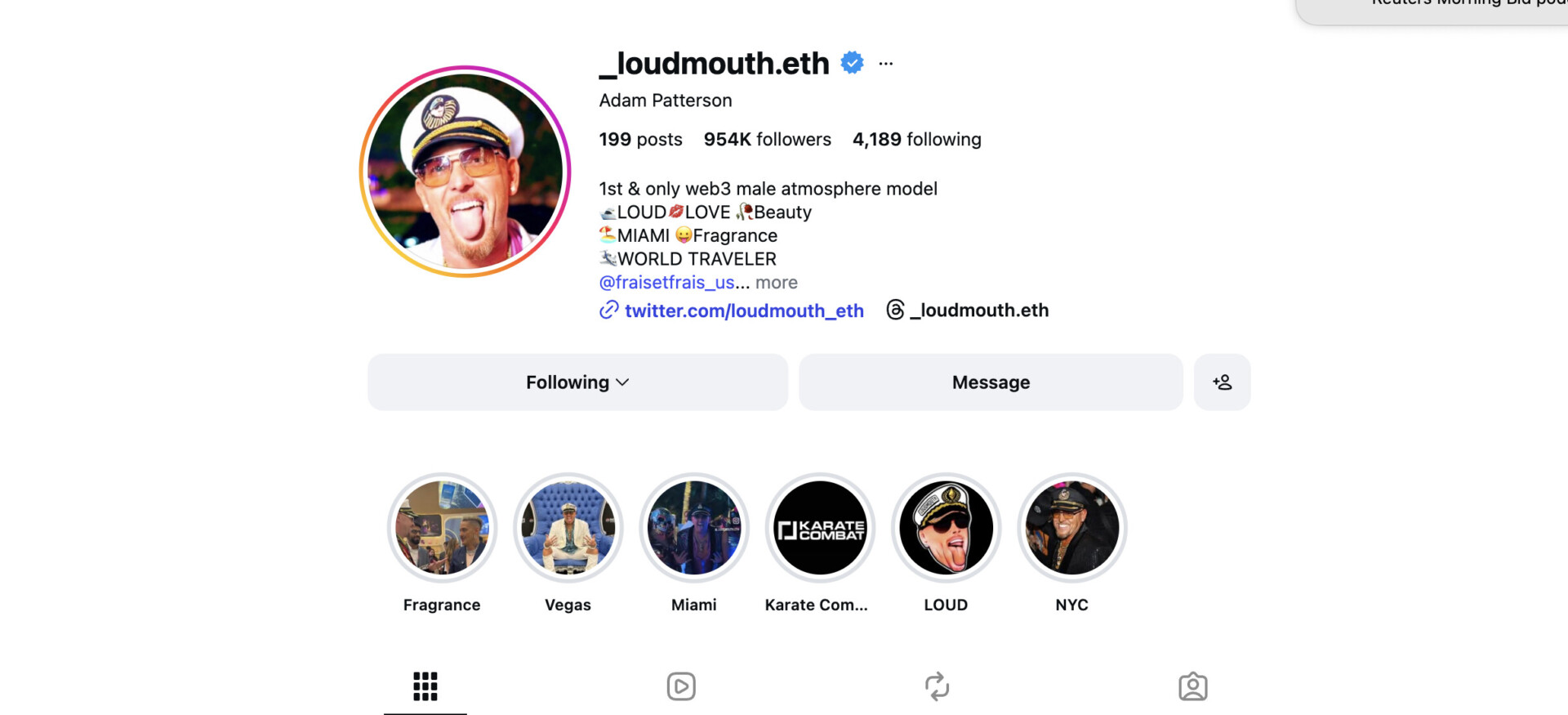 Screenshot of Loudmouth’s Instagram account
He also pushed back on the idea that Bitcoin is uniquely risky. During a ride to the event, an Uber driver told him Bitcoin was risky. Adam’s answer was, “Everything is risky. And it puts me back to this lie that a lot of people believe that it’s not that easy when it actually is if you just do it. But something can be very easy as well as difficult at the same time.”
That is how Loudmouth sees money too. He said currency is made to travel, not sit dead in someone’s pocket. Cash only has use when someone tells it where to go. The people who face problems, learn the tools, and act with speed are usually the ones who benefit.
Adam said the future is bigger than coins. He expects insurance policies, car titles, house deeds, health plans, medical records, and hospital files to end up on-chain.
His final point was not that Web3 should destroy Web2. He said the job is to take Web3 tools and apply them to older systems, so they become faster, clearer, safer, and harder to corrupt.











 English (US)