
 2 months ago
9268
2 months ago
9268

Aave DAO has voted to liquidate the frozen ETH funds from the KelpDAO hack. Aave has worked with KelpDAO, the LayerZero team, EtherFi, Compound, and other counterparties to recover as much funds as possible.
The Arbitrum Governance process asked for approval to release 30,765.67 ETH frozen by the Arbitrum Security Council to become a part of a coordinated remediation effort. The end goal is to make all rsETH holders whole by restoring the wrapped token’s ETH backing in full.
As Cryptopolitan reported, the ability to freeze and claw back funds has created a precedent in the crypto space, sparking controversy on the ability to compensate for earlier hacks. For now, the Arbitrum Security Council has only partially intercepted the hacker’s transactions.
As a result of the hack, KelpDAO has also decided to move its cross-chain infrastructure to Chainlink’s CCIP ecosystem. Previously, KelpDAO considered the Layer Zero cross-chain tools to be one of the main reasons for the $292M exploit.
90% of Aave representatives voted for the liquidation
According to Aave, a total of 1,600 addresses backed by 190M ARB tokens voted in favor of unfreezing the funds. Currently, the ETH is under the control of Arbitrum DAO.
The decision achieved a strong approval of over 90% during the week of voting. Aave considers the decision a precedent for future recovery efforts in DeFi hacks.
Stani Kulechov, the founder of Aave, announced that additional steps are coming to make Aave whole and compensate the bad loans.
As part of the technical implementation plan for rsETH recovery, the attacker’s position has now been liquidated on both Ethereum and Arbitrum.
This was an incredible technical effort by all contributors involved. Following up with the next steps shortly. https://t.co/KI9EOBXWU3
— Stani (@StaniKulechov) May 6, 2026
The Aave protocol also used its internal protection mechanisms against the hacker. After the exploit, some of the rsETH was used in attempts to take additional loans. However, when the token’s risk crossed a certain threshold, the hacker was liquidated. Despite this, Aave on Arbitrum estimated bad loans between $170M and $230M.
Aave strives to recover normal lending
Aave stabilized its value locked at above $15B following the initial outflow of $10B. Some of the leading vaults have improved their health, with utilization rates falling below 100%. The WETH lending vault has a utilization above 93%, while the USDT and USDC vaults sit at 92% and 91%.
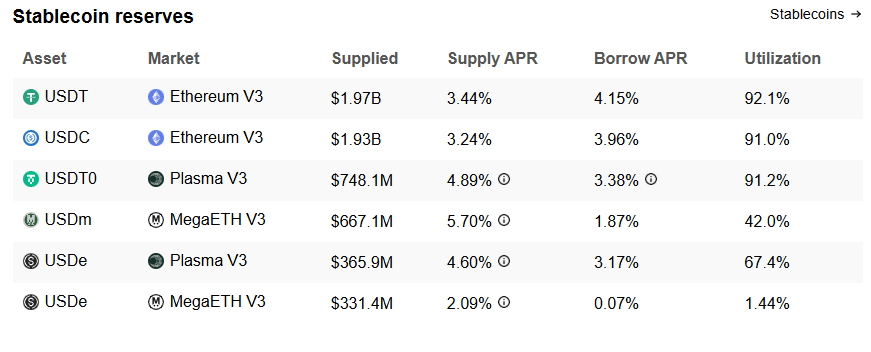 Aave stablecoin vaults have started normalizing their utilization and yield rates after the wave of withdrawals. | Source: AaveScan.
The utilization rates signal the run to withdraw from Aave has ended, but the overall effect is lower lending activity, which may have to go through a long recovery.
Lending in total has fallen by 35% in the past 30 days, while stablecoin liquidity has fallen by 46.3% for the past month, based on Aavescan data.
Despite this, the average lending rate has normalized to 2.76%, while the borrowing rate sits at 4.08%, with variations between specific vaults. Despite the drop, Aave lending is healthier compared to the 2022 crash, and is still considered central to DeFi activity.
Following the initial shock, the AAVE token stabilized at around $94, still showing weak signs of recovery despite the overall crypto market improvement. The protocol has retained its GHO tokens at over $538M, with no recent supply burned.
Your bank is using your money. You’re getting the scraps. Watch our free video on becoming your own bank


















 English (US)