
 1 month ago
7272
1 month ago
7272

Gold now makes up basically the entirety tokenized commodity market, according to data from a16z Crypto, whose latest report put tokenized commodities at about $5.1 billion, while tokenized gold alone sat near $5 billion.
Silver and every other commodity product had only $57.6 million combined, which leaves gold with about 98% of the market. Oil, farm products, energy, and compute tokens are still barely present.
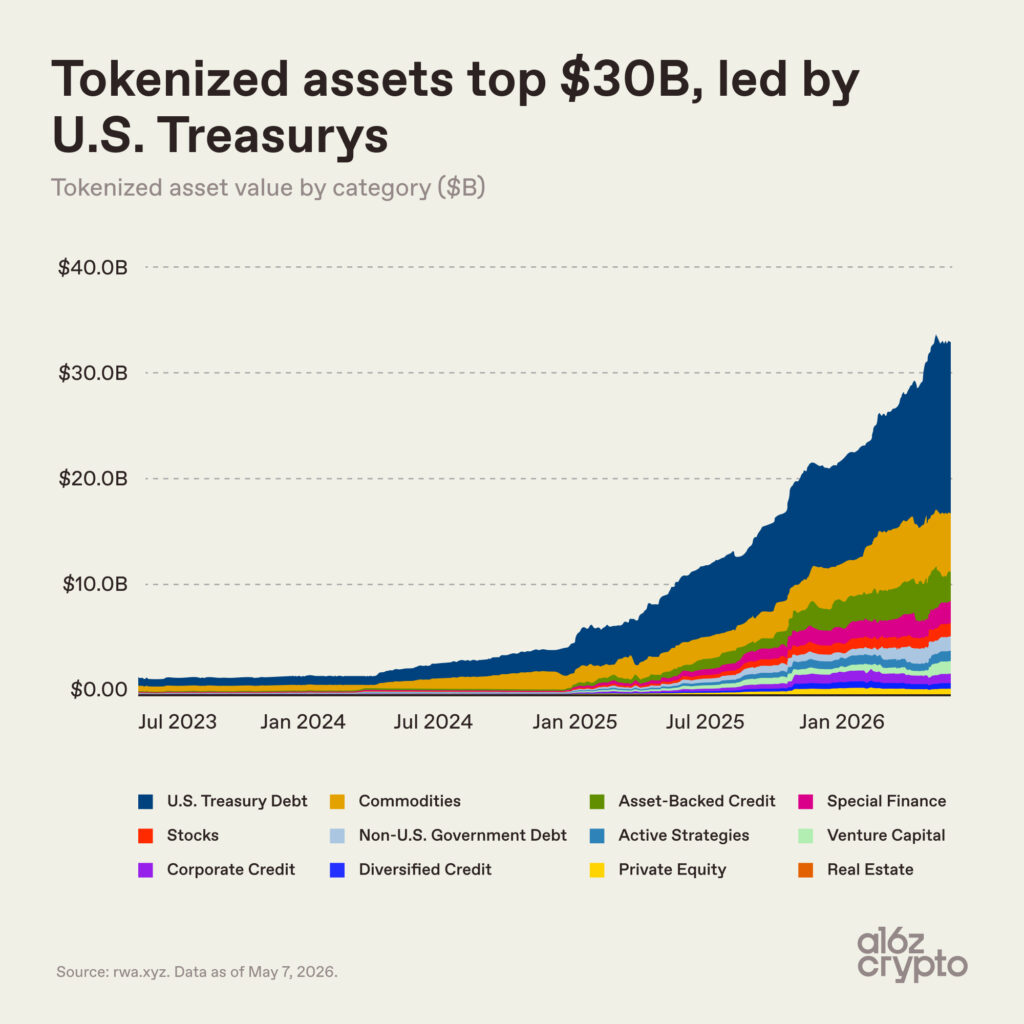
According to a16z Crypto, the market for tokenized assets, also referred to as RWAs, “has surpassed $30 billion recently and been hovering at $34 billion” without counting the stablecoins.
 Source: a16z Crypto
In mid-2024, the market value was less than $3 billion. This massive increase came about following the passage of the GENIUS Act which provided clearer laws for stablecoins in the USA.
Treasurys drive tokenized assets as gold controls the commodity side
U.S. Treasury debt has been the biggest driver of recent growth. a16z Crypto said “U.S. Treasury debt has driven most of the market’s recent growth.” Investors can hold a normal yield-paying asset in a faster digital form. Bonds are the largest tokenized asset class at $15.2 billion.
“For crypto investors, tokenized Treasurys also provide a way to put idle stablecoins to work while gaining access to traditional money-market yields. BlackRock, Franklin Templeton, and a growing number of asset managers have moved quickly to meet the demand, building a multibillion-dollar market around the idea,” said a16z.
Not every category grew at the same speed. Asset-backed credit, including tokenized HELOCs and lending vault tokens, reached $1 billion only 185 days after its first recorded onchain activity. Specialty finance came next. That includes tokenized reinsurance contracts and bitcoin mining notes, and it passed $1 billion in under two years.
 Source: a16z
Venture capital took more than seven years to reach $1 billion. Active strategies took almost as long. Government debt and commodities were faster, reaching $1 billion in about two to three years. By early 2024, those two categories had nearly the whole tokenized asset market.
Since then, asset-backed credit, specialty finance, stocks, and active strategies have gained share, but Treasurys and commodities still account for around two-thirds of the market.
Ethereum leads tokenized assets while most products stay outside DeFi
Gold fits tokenization because crypto traders love it, thanks to the gold link because bitcoin was called “digital gold” long before tokenized gold products became common. Tether’s XAUT and Paxos’s PAXG turn claims on vault-held gold into tokens that users can keep in crypto wallets.
Ethereum still has the largest share of the full tokenized asset market, with $15.7 billion on the network. BNB Chain has $4 billion, Solana has $2.2 billion, Stellar has $1.7 billion, and Liquid Network has $1.5 billion. XRP Ledger, ZKsync Era, and Arbitrum are each near $1 billion.
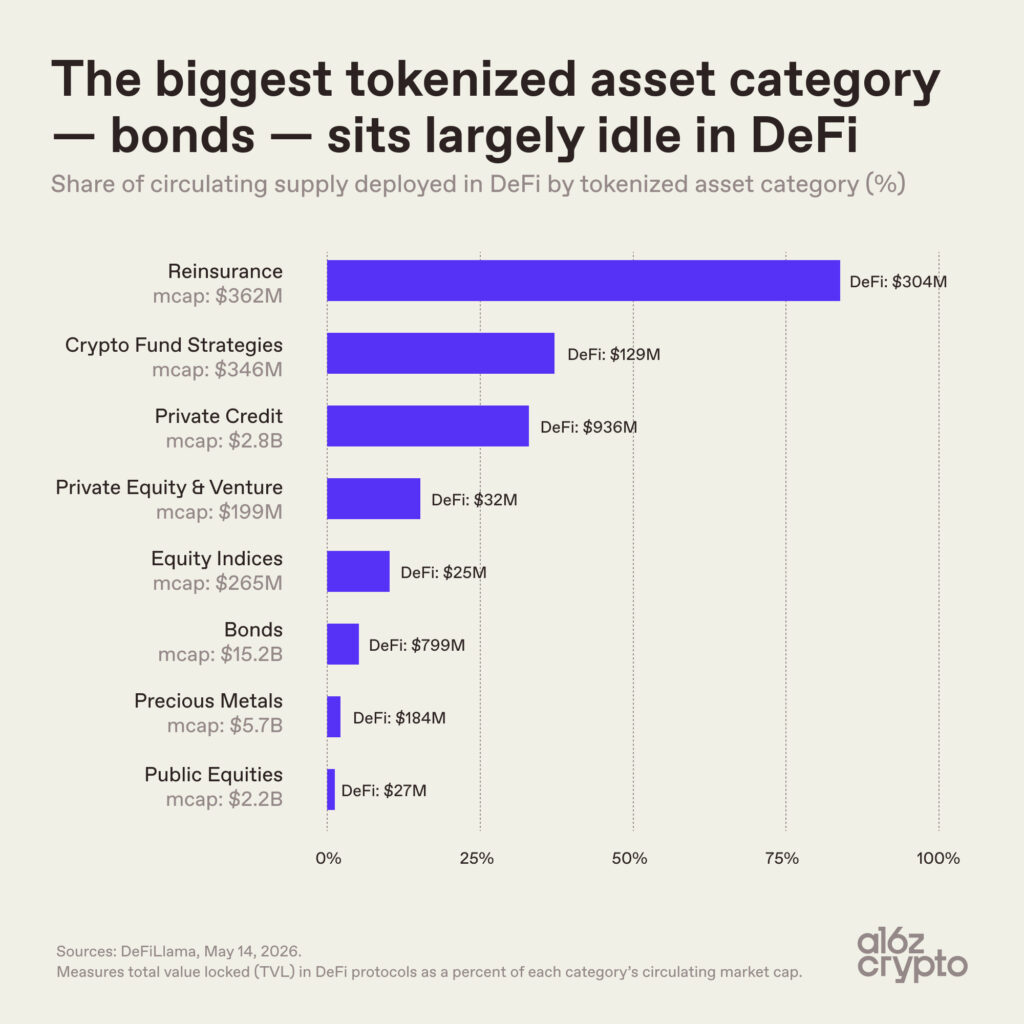
The usage numbers are not as loud as the market cap numbers. a16z Crypto said bonds are the largest category, but only about 5% of that supply, or around $800 million, is used inside DeFi protocols. Precious metals also have low use in DeFi. Most tokenized gold is held onchain instead of being used as programmable collateral or inside other apps.
a16z Crypto said the highest DeFi-use categories were built for onchain use from the start, including products tied to Nexus Mutual and Maple Finance.
The a16z report said:
“Some assets are freely transferable and usable across onchain applications. Others use blockchains mainly as recordkeeping infrastructure, with limited transferability or composability. (RWA.xyz, for instance, distinguishes between “distributed” vs. “represented” assets.) Much of what gets called “tokenization” today is actually closer to digitization.”
McKinsey sees the tokenized market a $2 trillion to $4 trillion by 2030, Ark Invest expects $11 trillion, BCG and Ripple put it at $9.4 trillion by 2030 and $18.9 trillion by 2033, while Standard Chartered (LON: STAN) projects more than $30 trillion by 2034.
Don’t just read crypto news. Understand it. Subscribe to our newsletter. It's free.

















 English (US)