
 2 months ago
10374
2 months ago
10374

Law enforcement and private-sector partners seized roughly 11% of illicit cryptocurrency volume in 2025, a rate 55 times higher than the recovery rate for traditional assets, according to data shared by Binance Research.
The research arm of the world’s largest crypto exchange reported that actions by Tether, Interpol, and the T3 Financial Crime Unit directly challenge the argument that crypto is a haven for criminals.
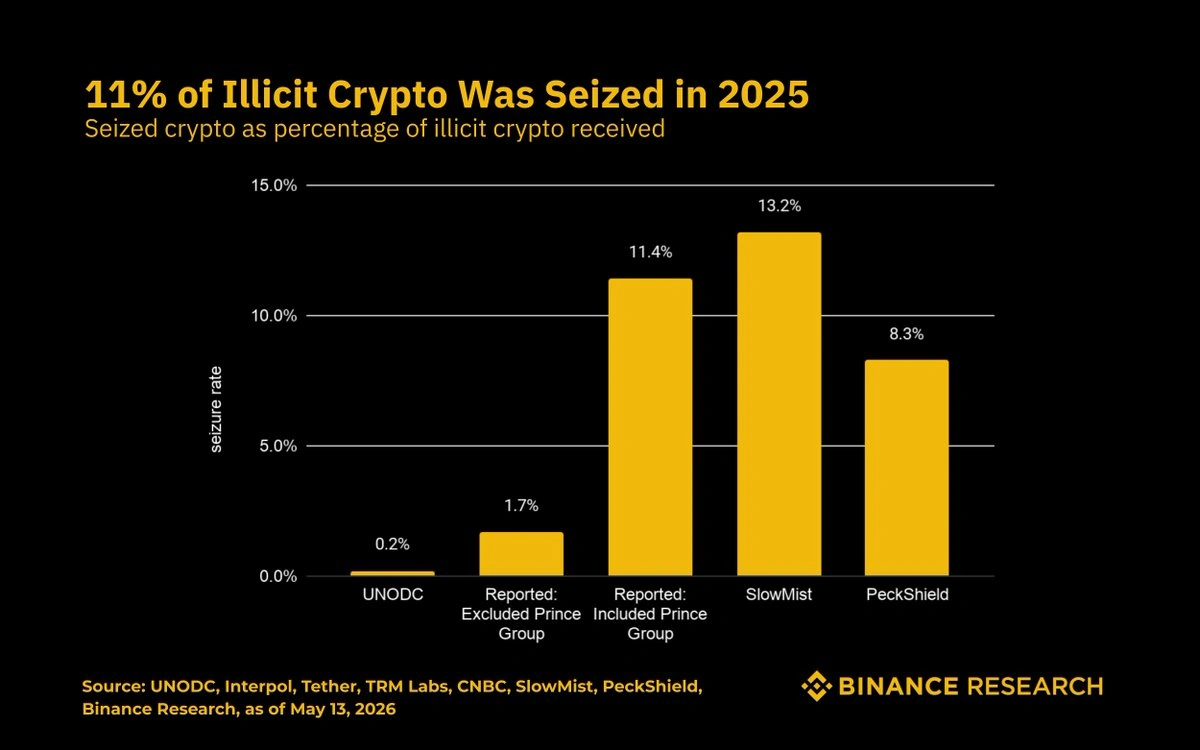 Binance Research claims illicit funds are seized 55x more often in crypto than in fiat currency. Source: Binance Research.
Binance contributes to the T3 financial crime unit
The T3 Financial Crime Unit (T3 FCU), a partnership between Tether, TRON, and blockchain analytics firm TRM Labs, recently announced that it has frozen over $450 million in USDT tied to criminal activity since its September 2024 launch.
The frozen funds are from illicit operations like money laundering, North Korea-linked cyber operations, drug trafficking, and violent crimes, including kidnappings. T3 FCU reported that its interceptions in 2025 were 43.9% higher than in 2024.
The group has already assisted in several high-profile cases across the globe, like in Spain, where T3 FCU helped the Guardia Civil freeze approximately $26.4 million connected to a European money-laundering network.
In Brazil, the unit assisted with “Operation Lusocoin,” a federal investigation that froze 4.3 million USDT as part of a larger seizure of more than 3 billion Brazilian reais (approximately $525 million).
In the aftermath of the Bybit hack, the unit identified nearly $9 million in funds traced to the exchange breach. Most recently, Tether froze $344 million USDT on TRON.
The Financial Action Task Force (FATF) cited T3 FCU earlier this year as “an invaluable resource for law enforcement agencies worldwide.”
Why are Binance’s crypto crime statistics being disputed?
The cryptocurrency industry frequently relies on data published by Binance Research, an arm of Binance, the world’s largest cryptocurrency exchange by volume. That data is now under direct scrutiny from the firms whose research Binance cited.
In November 2025, on the same day the International Consortium of Investigative Journalists (ICIJ) published The Coin Laundry, an investigation by more than 100 journalists across 35 countries that found hundreds of millions of dollars in suspect cryptocurrency flowing through Binance accounts, Binance released its own transparency report.
Binance claimed its direct exposure to illicit funds had dropped by 96% since early 2023, citing data from Chainalysis and TRM Labs. It also stated that only 0.007% to 0.023% of its transaction volume was directly linked to illicit wallets, and positioned itself as having the lowest crime exposure among its top competitors.
Chainalysis publicly distanced itself from Binance’s framing, stating it did not conduct the analysis. The firm also said that Binance did not include all the categories of illicit activity that it tracks. Specifically, Chainalysis said Binance’s numbers omitted funds stolen through hacks and ransomware proceeds.
TRM Labs’ head of policy, Ari Redbord, told ICIJ that the statistics Binance attributed to its firm only covered certain categories. The firm also clarified that the comparisons Binance drew to competing exchanges were not part of its analysis.
Binance acknowledged the analysis did not include every category of tracked illicit activity, stating that the excluded categories required “different methodologies” and are handled differently across data providers.
Binance remains under a three-year compliance monitoring program after its November 2023 guilty plea to U.S. anti-money-laundering and sanctions violations, which carried $4.3 billion in penalties.
Cryptopolitan recently reported that the U.S. Treasury pressed Binance to provide records related to that monitorship after reports that over $1 billion in crypto had flowed through the exchange to Iran-linked entities.
If you're reading this, you’re already ahead. Stay there with our newsletter.








 English (US)