
 3 months ago
12504
3 months ago
12504
.png)
Bitcoin is facing resistance after weeks of upside that carried it significantly above the lows that defined the worst of the correction. The recovery had been building momentum — and today that momentum met a specific kind of obstacle that XWIN Research Japan has analyzed in detail, with findings that change how the decline should be read.
Bitcoin briefly fell below $80,000 today. Ethereum dropped under $2,300. More than $90 billion was erased from the combined crypto market cap from recent highs, with approximately $331 million in liquidations over the past 24 hours — nearly $100 million of that occurring within a single two-hour window. The speed and scale of the move created the kind of alarm that typically accompanies a macro shock.
But the macro environment did not produce this decline. The S&P 500 and NASDAQ remained near record highs throughout the same period. Traditional equities did not sell off. Risk appetite in broader markets did not deteriorate. The forces that drove Bitcoin below $80,000 were not external.
According to XWIN Research Japan, the decline was driven primarily by internal crypto market structure — specifically the combination of leverage positioning that had accumulated during the recovery and profit realization from holders who had returned to profitability after weeks of recovery. The market did not break because of what was happening outside it. It broke because of what had been building inside it.
The Rally Created the Conditions for Its Own Interruption
The XWIN Research Japan report identifies the specific mechanism behind the decline with precision. On May 4, Bitcoin profit-taking reached 14,600 BTC in a single day — the highest level since December 2025. The 37% recovery from April lows had returned a significant cohort of investors to profitability, and many of them chose to act on that recovery simultaneously. The Short-Term Holder SOPR reaching 1.016 and remaining above 1.0 since mid-April confirmed the pattern: recent buyers were selling at a profit, and they had been doing so persistently rather than as a one-day event.

The behavioral dynamic behind the selling adds the human dimension. Between February and March 2026, many short-term traders were sitting on losses of 20% to 30%. April’s rebound did not just recover prices — it recovered those participants’ financial positions. Historically, that recovery from loss to break-even or profit is one of the most reliable triggers for renewed selling pressure. Participants who endured weeks of losses tend to exit the moment the market gives them the opportunity.
The leverage dimension accelerated what profit-taking started. Long liquidations intensified the downside momentum as derivatives positions unwound alongside spot selling, amplifying a move that began with profit realization into something considerably sharper.
The constructive element XWIN Research Japan preserves is the exchange inflow data. Large holder deposits remain relatively muted — suggesting the participants with the most coins and the most strategic patience have not yet begun aggressive distribution. That distinction separates a leverage-driven correction from a structural top. Bitcoin is at a genuine crossroads: the data supports either an early-stage bullish recovery with leverage now cleared, or the late phase of a bear market rally approaching its natural exhaustion.
Bitcoin Stalls Below Resistance As Recovery Meets Supply
Bitcoin is trading near $80,200 on the daily chart, holding just below a resistance zone that has repeatedly capped upside since the initial breakdown earlier this year. The recovery from the February low near $60,000 remains structurally intact, with price forming a sequence of higher lows and steadily reclaiming short- and mid-term moving averages.
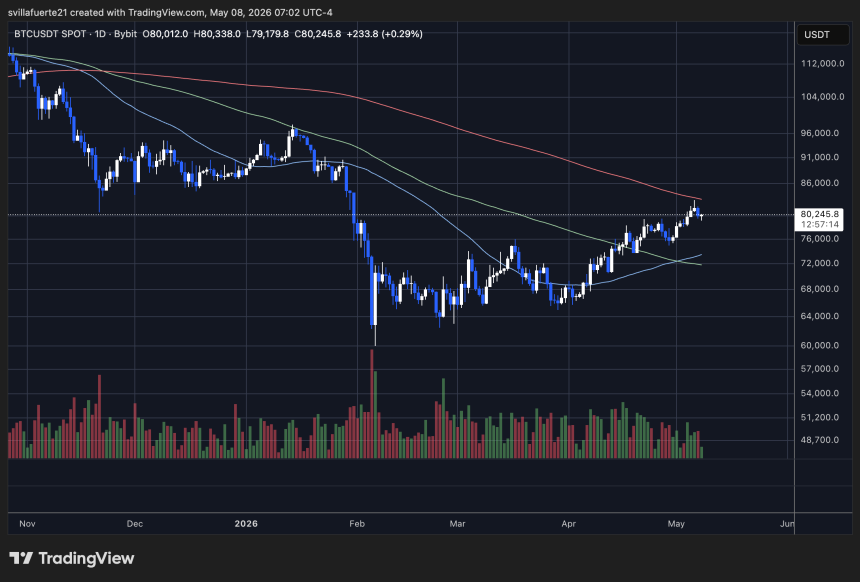
The 50-day and 100-day moving averages have both turned upward and are now acting as dynamic support in the $72,000–$75,000 region. This confirms that the trend has shifted from bearish to neutral-to-bullish in the short term. However, the 200-day moving average continues to slope downward above price, reinforcing the $80,000–$82,000 range as a critical supply zone.
Recent price action shows slowing momentum. Candles are compressing beneath resistance, and volume has not expanded meaningfully during the latest push. This suggests that while buyers remain present, they are not yet strong enough to force a decisive breakout.
If Bitcoin clears $82,000 with conviction, it would confirm continuation and open the path toward higher levels. If rejection persists, the market is likely to rotate back toward support, with $75,000 as the first level to watch and deeper demand forming closer to $70,000.
Featured image from ChatGPT, chart from TradingView.com













 English (US)