
 3 weeks ago
8606
3 weeks ago
8606
.png)
Uniswap pointed out that founder Hayden Adams believes that tokenization is going to change how liquidity is offered in cryptocurrency and traditional markets, while the automated market makers (AMMs) are still at the beginning of their journey, in an X post published on August 25.
This is significant considering the fact that AMMs conduct transactions in billions of dollars on a daily basis and could play an essential part in handling tokenized real-world assets that are being transferred to public blockchains.
AMMs make it possible for decentralized exchanges to provide pooled user deposits and set prices without involving an order book to match buyers to sellers. According to a working paper published by the Bank for International Settlements (BIS) in November 2024, AMM-based decentralized exchanges process over $10 billion worth of digital assets every single day.
If real-world assets (RWAs) shift on-chain, those markets will also need dependable liquidity. AMMs are one of the very few solutions capable of delivering liquidity at a large scale.
Tokenized assets are already moving into global markets
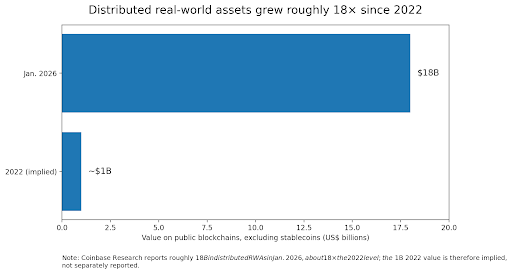
Coinbase Research has determined that approximately $18 billion in “distributed” RWAs, excluding stablecoins, had been placed on public blockchains in January 2026 – 18 times the respective figure for 2022. The bulk of that amount accounts for tokenized U.S. Treasuries. According to Coinbase data, BlackRock’s BUIDL fund has more than $2 billion of them, or nearly 25% of the total of tokenized Treasuries.
Regulations are also becoming much more defined. Coinbase indicates that with the initiation of the 2025 GENIUS Act and the reform of the Security Exchange Commission (SEC) under Paul Atkins, the environment in the U.S. for digital assets and tokenized financial assets is getting more favorable. In Europe, there is MiCA, which goes alongside the DLT pilot regime, while Singapore’s Project Guardian and the UAE’s VARA framework contribute to the formation of tokenization hubs in Asia.
The market infrastructure is improving. The Depository Trust & Clearing Corporation (DTCC) announced on July 15 that it has turned assets stored in its depository into tokens that will be used in live production trades involving over 30 conventional and digital market companies. DTCC intends to introduce its tokenization service in October 2026.
Why AMMs still look early
The aspect of “early stages” in Adams’ argument is evident from the current operation of AMMs.
According to the BIS study, only a small group of skilled participants provided between 65% and 85% of the liquidity provided on Uniswap V3. The orders from these participants acted like regular buyers or sellers and generated better profit than retail providers of liquidity.
Even though AMMs have democratized market-making, liquidity has become consolidated in the hands of specialists, similar to how it happens in traditional financial markets.
Moreover, tokenization does not bring liquidity on its own. As indicated by Cryptopolitan in Why Tokenized Assets Are Not Liquid (Yet), tokenizing an asset means that it is transferable, but it does not mean that it is easy to trade.
The on-chain markets still require market makers that are ready to provide two-sided quotes and hold inventory. Many tokenized funds as well as bonds remain available only to accredited investors and individual issuers, with thin secondary trading possible.
The regulatory question hanging over on-chain trading
Whether AMMs are legal hosts for tokenized securities is far from clear.
In a March 30, 2026 letter to the SEC’s Crypto Task Force, the Securities Industry and Financial Markets Association (SIFMA) argued that regulators should be focusing on the functions of a protocol, rather than its lack of decentralization — and that order routing, execution, price discovery and settlement functions may well be subject to securities laws.
SIFMA raised concerns about slippage, incentives for liquidity providers, pseudonymous trading and limited surveillance of market-manipulation opportunities.
This is a critical issue, since the resolution of this question will define where the markets for tokenized assets evolve. The DTCC’s launch of its own spot trading service in October 2026 suggests that the SEC’s treatment of AMMs will determine whether the market-making innovation Adams has proposed will happen on a public blockchain or inside a regulated exchange.
The smartest crypto minds already read our newsletter. Want in? Join them.

![Ripple [XRP] News Roundup: $2 Billion Whale Buy Meets a Make-Or-Break Resistance Wall](https://image.coinpedia.org/wp-content/uploads/2026/07/24163919/XRP-Price-Analysis-and-News-ETFs-RLUSD-and-Supply-Full-Bull-and-Bear-Case-Explained-1-1024x536.webp)













 English (US)