
 3 weeks ago
16715
3 weeks ago
16715
.png)
Based on blockchain analysis by Arkham, North Korean hackers have laundered over $30 million worth of Bitcoin through Hyperliquid over the last three weeks, according to reports. The developments come at a delicate time.
President Donald Trump and the Commodity Futures Trading Commission (CFTC) are attempting to bring the offshore derivatives exchange within the boundaries of the United States. The discovery of Arkham intensifies the unresolved question: is it possible for a decentralized venue to fall under American regulation without incurring the sanctions and unlawful financial risk avoidance that were purposefully avoided by the creation of permissionless DeFi?
Arkham’s data lands as Hyperliquid courts Washington
As reported by Cryptopolitan and various media outlets, Hyperliquid was subject to the same criticism in December 2024 in relation to wallets linked with North Korean parties. According to Hyperliquid, no hacking had taken place and no money had vanished from user accounts. The new transactions show that the association is still in place while Hyperliquid is becoming more popular in the US.
According to Chainalysis, the North Korean regime looted around $2 billion worth of cryptocurrency in 2025, its most prosperous year ever in this regard, with the funds allegedly used to fund its weapons programs. CertiK has said that the DPRK has stolen about $6.75 billion in total during 263 incidents since 2016. On August 11, the Royal United Services Institute published a report outlining how Pyongyang exchanges the looted crypto for fiat currency to support its programs and calling for stricter onboarding processes and information-sharing rules regarding virtual asset service providers.
A rental deal through Kraken’s parent, not a purchase
Hyperliquid Labs is currently having discussions with Payward, the parent company of Kraken, regarding a U.S. strategy. Instead of purchasing an exchange with a license, American registered traders will be able to make trades using specific Hyperliquid-related perpetual futures via Bitnomial, the CFTC-regulated clearinghouse operated by Payward. Payward has already submitted the plan to the CFTC but has not yet received approval.
The Hyperliquid application would still not be available to U.S. users and registered users of Bitnomial would have access only to a small portion of what Hyperliquid has to offer in terms of perpetual futures. Specific compliance levels in the app are unknown.
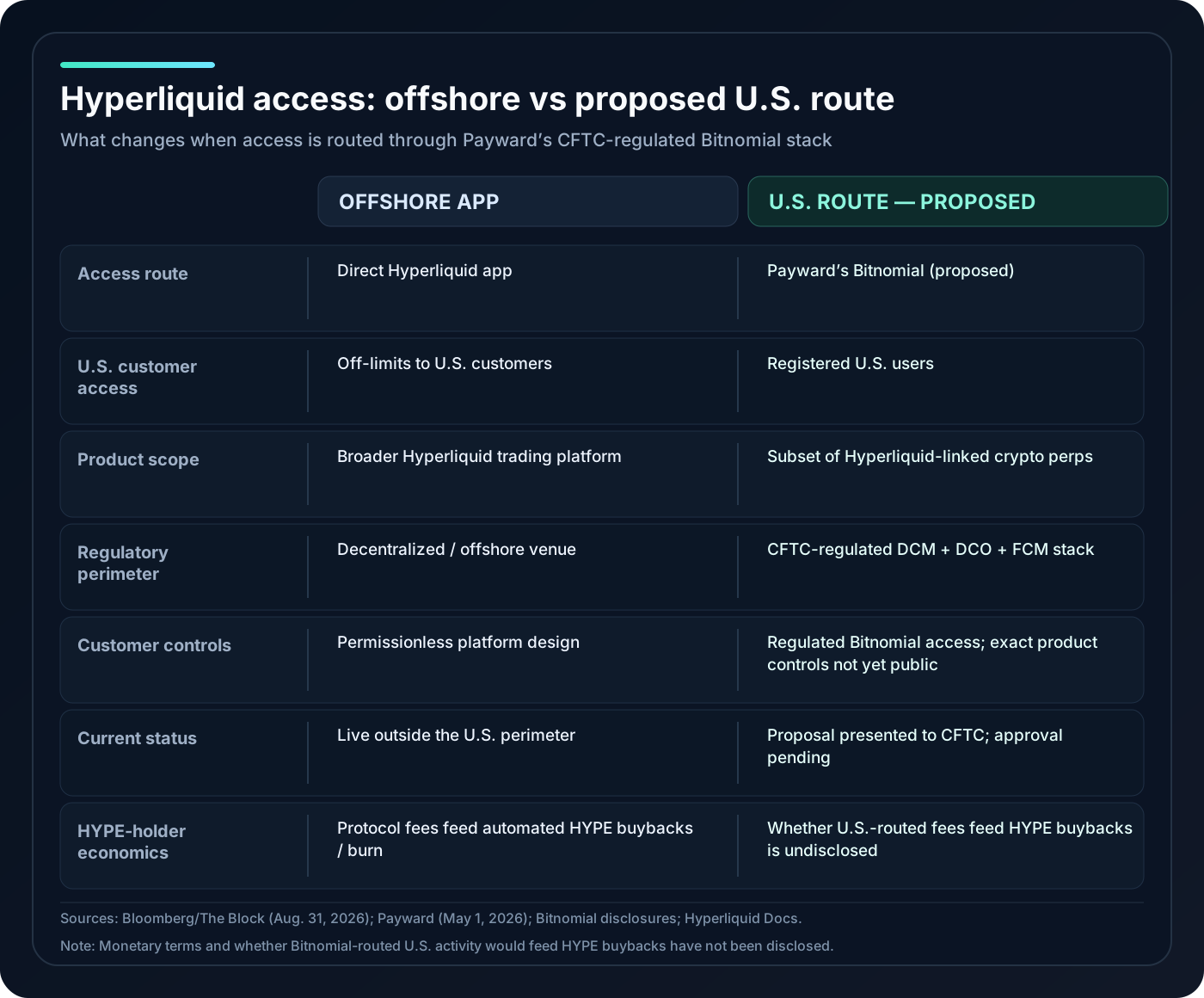
On May 1, Payward confirmed the successful acquisition of Bitnomial, which was valued at $550 million. This move gave Payward access to Bitnomial’s entire derivatives stack, which consists of a Futures Commission Merchant, Designated Contract Market, and Derivatives Clearing Organization, among others, that are registered with the CFTC.
The commercial logic runs through HYPE. Hyperliquid allocates 99% of protocol fees to its Assistance Fund, which automatically converts trading fees into HYPE. Its documentation says the fund’s HYPE is burned, permanently removing it from circulating and total supply. An SEC filing by Hyperliquid Strategies said 46.7 million HYPE, or 4.7% of initial supply, had been acquired by the fund and permanently removed as of August 23.
It is not known if the volume routed via Bitnomial would contribute to such a mechanism, nor infomation about the commercial agreement between Payward and Hyperliquid has been provided. The flat licensing fee and the percentage of the U.S. trading income could mean something very different for HYPE investors. HYPE reached its all-time high of $86.71 on August 27, while there were not a single U.S. trader using the outlined route.
The perimeter question critics keep raising
Trump during a meeting at the White House on August 19 referred to CFTC Chairman Michael Selig as playing an important role in making the crypto trading platform of Hyperliquid “fully compliant and legal”. Following this comment, HYPE saw a spike of almost 17%. Further reports from Cryptopolitan indicate that the CME Group and ICE participated in the meeting too but they have been pushing regulators to investigate Hyperliquid for price manipulation and sanctions exposure.
That is the key point – when it comes to onshoring a decentralized platform, one has to account for customer verification, market surveillance, and checking for sanctions – which are the processes that the DeFi sector minimizes. Arkham’s figures illustrate what these measures need to uncover on the market.
The investors’ enthusiasm keeps growing. The Bitwise fund launched its spot Hyperliquid ETF, BHYP, on May 14, trading it at NYSE Arca and using Anchorage Digital Banking as its digital asset custodian.
What the CFTC proposal does and does not settle
The reported on-chain movements do not establish who controlled the receiving exchange accounts or whether the exchanges knew the funds were linked to Lazarus. CoinDesk also notes that public blockchain data cannot show all compliance actions taken after assets reach a centralized exchange. Hyperliquid has yet to explain publicly how its architecture can screen or block the Lazarus-linked wallets identified by Arkham.
A proposal is not a clearance. Hyperliquid and Payward declined to comment, and no final registration terms, timetable or product-specific compliance framework is public. Payward has reportedly presented the basic structure to the CFTC, but final regulatory approval remains pending.
Until regulators act, onshoring remains a proposal, and the North Korean transfers remain a reminder of what supervisors would be signing up to police.
The smartest crypto minds already read our newsletter. Want in? Join them.







 English (US)