
 1 hour ago
1057
1 hour ago
1057
.png)
SpaceX launched Starship into orbit for the very first time on 28 September 2026, releasing 26 operational Starlink V3 satellites. However, due to engine failure, SpaceX had to cut the mission short. This flight demonstrated that the Starship can lift up SpaceX’s biggest satellite, but it didn’t prove that the company can maintain a sufficient launch frequency.
An engine dropped out on the way up
Starship successfully took off from Starbase,Texas at 7:48 a.m. CT. During its ascent, one Super Heavy engine switched off, which was soon followed by an early shutdown of a vacuum Raptor engine on the upper section of the spacecraft. As a result, Starship effectively adapted by utilizing the rest of its engines for a longer period of time before concluding its orbital burn after the flight managers checked the status of the craft.
The spacecraft accomplished its mission of reaching low-Earth orbit at an altitude of about 275 kilometers and releasing its batch of 26 Starlink V3 satellites. SpaceX wanted to accomplish about six orbits during a period of nearly ten hours, but due to the engine problem, the mission was terminated after only about three hours. According to SpaceX:
“The Starlink V3 satellite is designed to support 1 Tbps of downlink and 160 Gbps of uplink capacity.” — SpaceX
This signifies the newly introduced additional 26 Tbps of possible network capacity, which is nearly 10 times higher than the capacity provided by a Falcon 9 launch of the V2 Mini satellites.
Why orbit was the milestone SpaceX needed
According to a report from Cryptopolitan, putting Starship into orbit is the main obstacle that SpaceX must overcome before it can begin deploying V3 and proceed to conduct refueling tests in space.
Starlink is already the leading name in consumer satellite broadband. Research conducted by Ookla indicates Starlink’s share of worldwide satellite Speedtest samples as of Q3 2025 is 97.1%, while Viasat holds only 1.7%. That represents a usage-sample measure, not subscriber market share.
Additionally, as of March 31, 2026, SpaceX has recorded approximately 10.3 million subscribers for its Starlink service. Starship will help to increase this advantage since it is capable of carrying more V3 capacity on each mission than its predecessor Falcon 9.
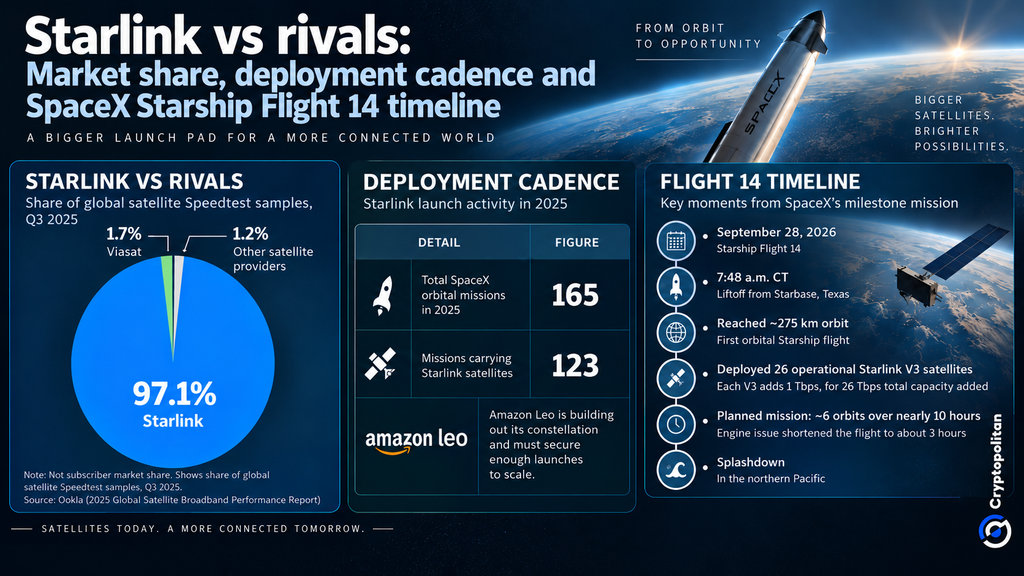 Starlink vs rivals: Market share, deployment cadence and SpaceX Starship Flight 14 timeline
A $626 billion market leaning on satellites
In 2025, the broader space economy had generated nearly $626 billion in revenue. Around 78% of that came from commercial activity. Nevertheless, the OECD has issued a warning about strategic vulnerabilities resulting from reliance on space infrastructure that may allow for concentration in the markets.
The benefits are sizable. According to Oxford Economics, LEO broadband is set to cater to 78 million to 421 million users and in doing so, add anywhere between $32 billion and $863 billion to global GDP by 2035, depending on various factors including policies, affordability, and competition.
What happened on Flight 14 was more than just a technological achievement but it also provided SpaceX an opportunity to see how Starship can speed up the rollout of Starlink. The next step is finding a way to ensure that more such successful orbital trips can be accomplished by SpaceX in the future.
Don’t just read crypto news. Understand it. Subscribe to our newsletter. It's free.
















 English (US)