
 3 months ago
12543
3 months ago
12543

SpaceX is pushing for what could be the biggest stock offering ever. But there’s a problem with the timing.
Reports last week said the company plans to file IPO paperwork as soon as this week. They want to raise $70-$75 billion, with the company valued at $1.75 trillion. Those are massive numbers that would shatter records.
Betting markets aren’t convinced the IPO will happen as quickly as reported, though. On Kalshi, people are giving it just a 6% chance of an official announcement before May 1. That goes to 25 percent for June 1. By July 1, it’s 66 percent. Polymarket users think there’s a 59% chance the entire process will finish by the end of June.
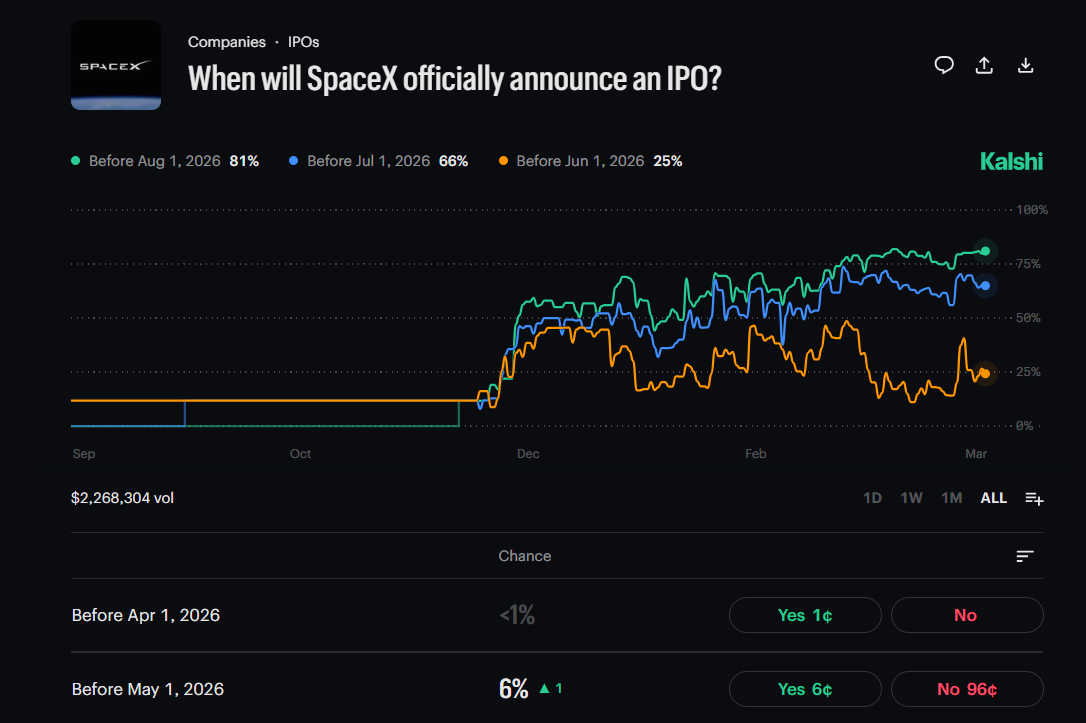 Source: Kalshi
xAI loses entire founding team
The doubt makes sense when you look at what’s happening with xAI.
Musk’s AI company lost its last original co-founder on Friday. Ross Nordeen walked out, and his employee badge on X was removed as well. That completes a total wipeout of the founding team.
Eight of xAI’s 11 co-founders have left since January. The entire group is basically gone.
Nordeen wasn’t a small player. The 36-year-old Michigan Tech graduate reported straight to Musk and ran operations across the company. Before xAI, he was at Tesla managing Autopilot programs and building data centers for their self-driving training. He’s also friends with Musk’s cousin, James, according to Walter Isaacson’s book.
So what are investors actually buying here?
Musk is doing something unusual with this deal. As reported by Cryptopolitan previously, he wants to give retail investors as much as 30% of SpaceX when it goes public. That’s way more than the typical 5% to 10% that regular investors usually get in most IPOs.
Musk is personally picking which banks do what. Bank of America will handle retail investors in the United States. Morgan Stanley will bring in smaller investors through its E*Trade platform. UBS is targeting wealthy investors outside the US. Citi is running global distribution for both retail and big institutions.
Well, SpaceX has real wins. The reusable rockets cut launch costs and changed the industry. Starlink runs over 10,000 satellites, has more than 10 million paying customers, and makes money.
Now they’re moving into wireless spectrum. The FCC confirmed Thursday that SpaceX is bidding in an auction starting June 2 against T-Mobile, Verizon, AT&T, and others. They dropped $17 billion last year on spectrum from EchoStar.
SpaceX will likely go after unpaired blocks to beam internet directly to phones. Citi analyst Michael Rollins said Friday the auction should be competitive with this many bidders. The spectrum works with current devices and networks. He thinks it’ll take several weeks.
Space-based AI data centers drive valuation
Starlink explains part of the jump from $800 billion valuation at the end of 2025 to about $1.3 trillion now. The other piece is Musk’s space-based AI data center plan.
The pitch is simple. Solar power in space is unlimited. Musk thinks running data centers in orbit will be cheaper than on the ground within a few years. Technical hurdles remain, but investors are buying in.
When SpaceX management starts talking publicly during the IPO process, investors will get details on strategy and growth. They’ll learn which competitors face the biggest threats.
But xAI losing every founder is a major red flag. It raises questions about how Musk runs these companies. Investors have to decide if SpaceX’s track record beats the leadership mess. Or wait to see if the betting markets are right about this dragging into summer.
Your bank is using your money. You’re getting the scraps. Watch our free video on becoming your own bank















 English (US)