
 3 months ago
12247
3 months ago
12247
.png)
Ray Dalio has reopened one of crypto’s longest-running macro debates, arguing that Bitcoin still has not behaved like the safe-haven asset many investors expected it to become. The Bridgewater Associates founder said gold remains structurally superior as a reserve and crisis asset, drawing immediate pushback from Michael Saylor and several Bitcoin advocates.
In a May 11 post on X, Dalio said Bitcoin “gets a lot of attention” but has not fulfilled the defensive portfolio role often assigned to it by supporters. His critique focused less on Bitcoin’s long-term price performance and more on market structure, privacy, correlation and reserve-asset adoption.
“While Bitcoin gets a lot of attention, it hasn’t played the safe-haven role many expected. In my view, there are a few reasons why. First, Bitcoin lacks privacy. Transactions can be monitored and potentially controlled, which is why central banks aren’t looking to hold it.”
Dalio then tied that transparency issue to Bitcoin’s behavior during market stress. “Second, it also has a high correlation with tech stocks. When investors get squeezed in other areas of their portfolio, they sell their Bitcoin to cover it. Third, it’s a relatively small and controllable market, whereas gold stands alone. There is only one gold.”
The argument places Bitcoin in the risk-asset camp rather than the sovereign reserve-asset camp. In Dalio’s framing, a safe haven is not defined by scarcity alone, but by how widely it is held, how independently it trades under pressure, and whether major institutions, especially central banks, are structurally willing to own it. “Ultimately, gold is more widely held, deeply established, and still plays a central role in the global system,” he wrote.
That view is consistent with Dalio’s public stance over the past several years. In 2021, he called Bitcoin “one hell of an invention” and said there were few “alternative gold-like assets” at a time of rising demand for stores of value. But even then, he treated Bitcoin as an emerging, option-like monetary asset rather than a finished replacement for gold.
More recently, Dalio has repeatedly favored gold over Bitcoin as a defensive asset. Business Insider reported in March 2026 that Dalio said Bitcoin would not seriously challenge gold as a safe haven, partly because central banks were unlikely to hold it as a reserve asset. Investopedia similarly reported that Dalio has acknowledged holding a small amount of crypto while continuing to prefer gold, citing concerns around privacy, government action and Bitcoin’s still-unproven role as a reserve currency.
Bitcoin Community Reacts
Michael Saylor, whose company Strategy has built its corporate identity around Bitcoin accumulation, rejected Dalio’s premise. “Gold is analog capital. Bitcoin is digital capital,” he wrote. “Transparency is a feature, not a bug, making BTC suitable as global collateral.” Saylor also argued that since Strategy adopted its Bitcoin standard on Aug. 10, 2020, Bitcoin had outperformed gold with a higher Sharpe ratio.
Other responses challenged different parts of Dalio’s thesis. Samson Mow disputed the claim that Bitcoin lacks privacy, writing that Dalio needed to “educate” himself. Mert Mumtaz, the Helius CEO, pointed instead toward Zcash, posting: “look into Zcash and thank me later.”
Anchorage researcher David Lawant framed Bitcoin’s current limitations as part of a longer monetization process: “Could it also be that BTC is just newer and that the monetization process of a commodity in the free market can take a long time? If so, this is actually a positive for forward-looking holders. It’s where asymmetric upside ultimately lies.”
Bitcoin-firm River took the argument in a more user-centric direction, saying Bitcoin is already a safe haven for people and businesses whose purchasing power is being eroded by central banks. The firm argued that gold remains relevant but cannot be used digitally, moved across borders with the same ease, or integrated into payments in the way Bitcoin can.
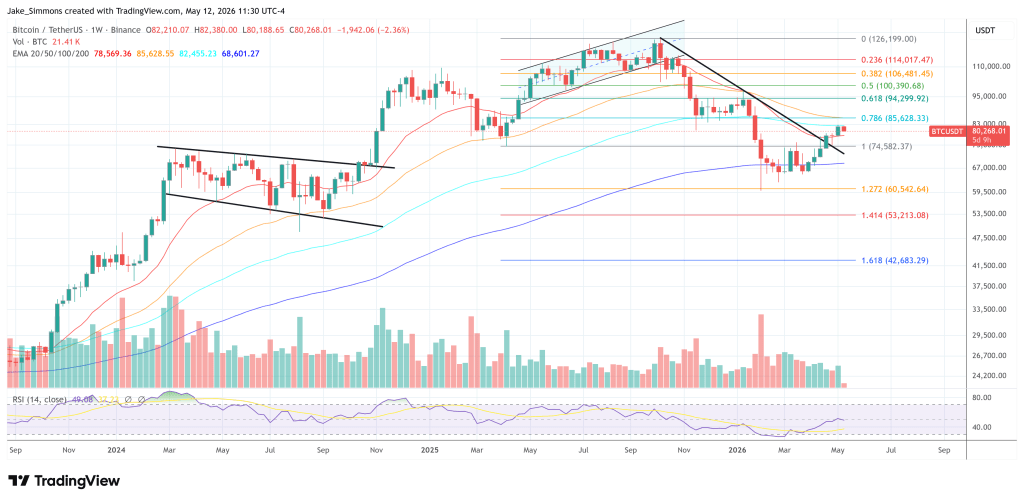
At press time, BTC traded at $80,268.










 English (US)