
 1 month ago
9866
1 month ago
9866
.png)
Strategy (NASDAQ: MSTR) chairman Michael Saylor has mapped Bitcoin, two of his company’s yield products, and Tether onto a single monetary scale.
Observers are saying Saylor is trying to tell investors which digital assets to hold for growth and which to hold for stability; however, he did not confirm it.
Four labels, one sliding scale
Saylor shared his thoughts in a post on X on August 13, where he classified assets from most volatile to most stable.
Bitcoin was one of the assets that Saylor labels as “Digital Capital.” Saylor classified Strategy’s STRC as “Digital Credit,” the SR-strcUSX token as “Digital Money,” and Tether’s USDT as “Digital Currency.”
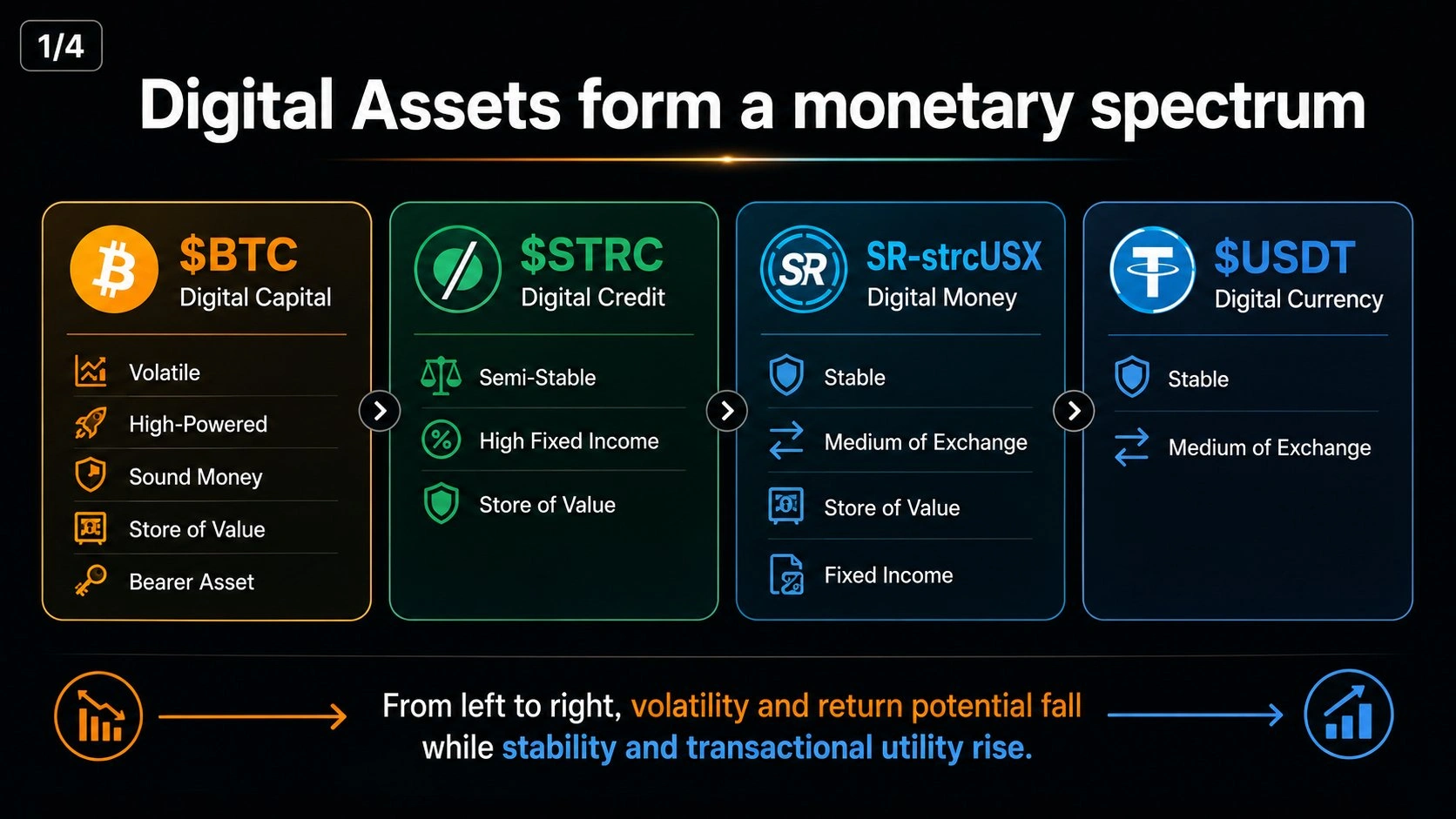 Digital assets volatility spectrum. Source: Michael Saylor via X/Twitter.
The assets were arranged on a table, with Bitcoin starting from the left, followed by STRC, SR-strcUSX, and USDT, with Saylor stating that volatility and return potential drop rightward, while stability and everyday usability rise.
Per Saylor, Bitcoin is the ultimate store of value, while a stablecoin like USDT is the ultimate medium of exchange in the digital economy. The two Strategy-linked instruments filled the space in between them.
Where does STRC sit in all of these?
STRC, nicknamed “Stretch,” is the piece doing the heavy lifting in Saylor’s middle tier.
It is Strategy’s variable-rate perpetual preferred stock, currently paying a 12% annual cash dividend in twice-monthly installments. Strategy’s board sets that rate and must declare each payment, and the stock can keep distributing cash even as its market price slides.
Saylor now brands it as digital credit, and he says it is a semi-stable, high-fixed-income store of value. He stated that financial engineering is what transforms digital credit into digital money.
Saylor wrote, “Digital Money combines the technology of Digital Currency with the economics of Digital Capital: stability, income, transactional utility, and a Store of Value.”
However, this is not the first time that Saylor is mentioning digital credit. On August 7, he told his followers that anyone hunting for “the next billion-dollar unicorn business in finance” should “study digital credit.”
Strategy, which holds a corporate Bitcoin treasury, has been recycling BTC into these preferred shares. The company sold 1,690 Bitcoin for $108.6 million on August 10 and used the cash to buy back roughly 1.15 million STRC shares, leaving it with 840,447 BTC.
The bridge lands on Solana
Saylor’s “digital money” tier points at strcUSX, a product that Solstice Finance put on Solana this week. Solstice Finance, which describes STRC as the link between Bitcoin and stablecoins, built a vault that hands users exposure to STRC’s dividend income and price risk without handing them the shares themselves.
Depositors put in Solstice’s USX settlement token and receive one of two tranches. The senior token, SR-strcUSX, gets paid first and aims for a 7% annual yield. Solstice calls it the first STRC-linked instrument on Solana.
Digital credit heads to Brazil
A few hours before he posted about digital assets on a monetary spectrum, Saylor had written about digital credit going to Brazil. He was responding to OranjeBTC’s announcement that it is launching DIGY11, which it calls “the first ETF of preferred shares from the Bitcoin ecosystem with monthly distributions.”
Saylor said that DIGY11, a B3-listed ETF, will carry STRC into Brazil with monthly payouts in reais, daily liquidity, and currency hedging.
If you're reading this, you’re already ahead. Stay there with our newsletter.













 English (US)