
 54 minutes ago
1066
54 minutes ago
1066
.png)
On Tuesday, Kamino has appointed Michael Weisz as the chief executive and announced the establishment of an institutional team in New York City, which focuses on a more important question than whether real-world assets (RWAs) can be tokenized: can the approximately $4 billion worth of RWAs on Solana be leveraged for loans instead of sitting stagnant?
On this front, Solana has answered the first question. The total value of RWAs on Solana reached over $4 billion in August across more than 350,000 wallets. The largest borrowing protocol in Solana, Kamino, decided that the next stage must come from converting the tokenized value into continuous demand for lending.
Why a Yieldstreet veteran is running a Solana protocol
Weisz co-founded Yieldstreet, known as Willow Wealth, where he took part in growing distribution for private-market investments. While announcing his move to Kamino on his LinkedIn account, he also emphasized that tokenization was just the beginning of it all. In order for the market to work, it also needs liquidity, credit, distribution, and infrastructure. Kamino also announced his appointment on its X account.
We are thrilled to announce Michael Weisz (@WeiszM) as the new CEO of Kamino After more than a two decades in fintech & private markets, Michael joins Kamino to lead us into our next chapter of institutional growth, and expand Kamino to the US market A letter from Michael below https://t.co/FjxtkN1dvn
— Kamino (@kamino) September 15, 2026Kamino’s institutional approach comprises the following points: distribution, legal and compliance, asset-manager operations, as well as credit and liquidity. Kamino is currently forming a new team in New York, which will involve professionals from finance, law, product, compliance, and business development, putting it closer to the asset managers, financial platforms, and capital providers it wants to serve.
Market size is not market utility
In terms of RWAs, Solana’s numbers appear good, but that does not necessarily correlate with trading activities and the availability of credit facilities. For the one-year period until August 18, Solana recorded 32% of on-chain RWA spot trading and 47% of all RWA transactions, while controlling a mere 12% of the total RWA market capitalization.
In other words, the total dollar value transacted through Solana up to this point is $14.7 billion out of $46 billion total in the period. The median RWA trade through the Solana network was $29 compared to $70 elsewhere, while BlackRock’s BUIDL fund of $741 million did not execute any trades over Solana.
A publication from the FinTech journal in July on RWAs built on Ethereum showcased similar realities: tokenization does not provide any liquidity on its own, and there is no guarantee that greater asset values correlate with higher trading activity. The research covers Ethereum and doesn’t address Solana directly, so the comparison is directional rather than direct.
Galaxy Research has explained the gap as follows:
“Capability now runs ahead of adoption, and H2 2026 will test whether that gap closes.” — Galaxy Research
According to Galaxy, much of the tokenized value of Solana is still not in use, and lending markets have failed to turn the emerging pool of assets into a sustainable demand for loans.
The Figure test case, and what Kamino’s own data shows
The early project that gives the best insight is PRIME, a product for liquid staking that is connected to the on-chain lending framework which Figure is employing in its operations. Figure established an RWA consortium on the Solana platform in December 2025 with Kamino acting as its exclusive partner for on-chain credit and lending services.
As claimed by Figure, they have issued more than $19 billion worth of on-chain loans, and the company is in control of 70% of the RWA private-credit market. In the end, PRIME generates yield from pools that include Figure’s home-equity loans, linking it to real borrower cash flows.connection between the project and the money flows of legitimate borrowers.
However, Kamino’s August figures illustrate how far credit utilization has yet to go. RWAs comprised 17.2%, or $426.1 million, of Kamino Lend supply, while total RWA and liquid-staking-token debt was below $3 million. Additionally, PRIME reported $13.6 million in net outflows and ONyc overtook it as the top RWA asset by supplied value.
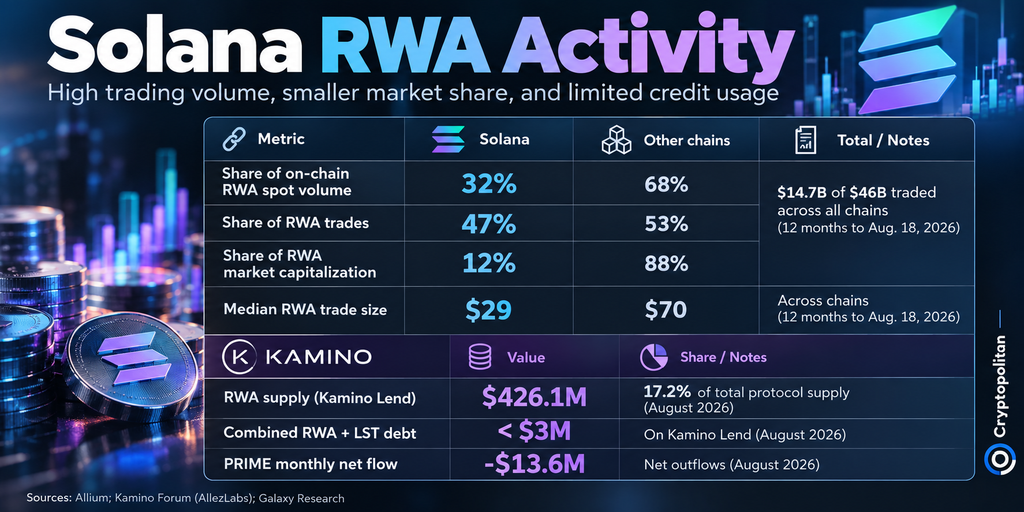 Solana RWA Activity vs Credit Use: Kamino Supply, Debt and PRIME Outflows
A capacity upgrade underneath the pitch
The network itself is becoming better suited to more complex institutional activity. Solana activated Transaction V1 on mainnet Tuesday, raising maximum transaction size from 1,232 to 4,096 bytes, or about 3.3 times more room, according to Cryptopolitan’s reporting.
That gives complex instructions, larger multisig operations and proof-heavy workloads a better chance of fitting into one atomic transaction instead of being split across several.
More capacity, however, does not guarantee more use. Kamino’s real test is whether asset managers, lenders and borrowers start routing meaningful credit through Solana. That is the gap Weisz has been brought in to close.
The smartest crypto minds already read our newsletter. Want in? Join them.















 English (US)