
 1 hour ago
1
1 hour ago
1

Remixpoint has just announced a major change in how it plans to use funds from a recent share issuance. Rather than funnel funds into Web3 investments, it will refocus on EVs, it has said, triggering speculation on what will happen to its BTC holdings.
Remixpoint has decided to reallocate ¥1.2 billion from a recent share issuance that was originally earmarked for Web3/crypto investments to its core “battery and energy businesses,” a decision that reportedly stems from a “challenging environment” and the scarcity of short-term, high-growth Web3 projects that balance returns and risks.
Rather than use those funds to buy more BTC for its treasury, they will now go towards enhancing EV-related operations, like charging stations and energy optimization, an aspect of business that is core to Remixpoint’s DNA and Japan’s 2035 phase out of gas cars.
Remixpoint pivots to focus on EVs
The announcement has triggered speculation on what will happen to the company’s stash of BTC. But for now, there has been no talk of sales, and the company’s existing holdings are expected to remain untouched as they plan to “HODL” long-term.
Remixpoint reportedly started building its BTC treasury in 2024 as a way to hedge against the national currency, similar to Metaplanet. By November of that year, it had accumulated up to 216 BTC.
The value of its holdings has since increased significantly, crossing the 1,300 mark around September this year. This is why it shocked many when, on October 23, Remixpoint announced that its board of directors had resolved to suspend equity financing (fundraising involving the issuance of new shares) for the purpose of acquiring crypto assets.
As a result of this decision, the company said it would not issue shares, including stock acquisition rights, when acquiring additional cryptocurrencies such as Bitcoin in the future, but will instead use cash on hand. The announcement was seen as an attempt to avoid dilution of the value per share that would accompany the issuance of new shares.
Despite the announcement, the company continued its aggressive investment stance by purchasing additional Bitcoin worth a total of approximately 570 million yen over five installments during October, and all of the funds for those purchases were raised through the exercise of the 25th stock acquisition rights.
Remixpoint pivots as new selling pressure hits market
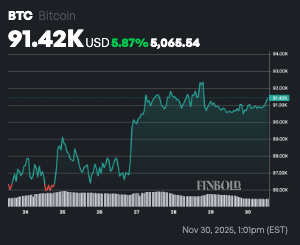
The recent sell-off in cryptocurrencies has resumed, and BTC and Ether have already shown sharp declines, with Bitcoin hovering around the $84,000 after sliding nearly 8% while Ether has dropped by around 10% to the $2,700 range.
Solana was also last seen around $124, while other closely watched tokens were also in the red. Analysts say the fresh slide in digital assets aligns with a broader risk-off sentiment at the start of a new month.
According to Ben Emons, founder and CIO of Fedwatch Advisors, people remain “nervous” following the recent Bitcoin sell-off, adding that Monday’s reversal has broadly been linked to a $400 million exchange liquidation.
Speaking with CNBC’s “Squawk Box Europe” on Monday, he highlighted the sizable leverage across Bitcoin exchanges, which is up to 200x in some instances, and said he expects more of these liquidations to follow if Bitcoin prices don’t rebound from here.
Monday’s dip came on the back of a sharp sell-off in October, which also affected the stock market, Emons said, with Bitcoin showing greater correlation with certain indexes, including the Nasdaq.
“It’s predominantly retail driven, that’s the worrying part of it, because retail reacts very differently than institutional [investors],” he said, highlighting the decentralized nature of crypto exchanges and the opaque nature of the asset class. “That is something to reckon with going forward from here, as more and more leverage is used in this space.”
There is also the issue of macroeconomic concerns, like the uncertainty over a possible U.S. rate cut, that continue to weigh on investors’ minds, as well as nagging doubts over overheated valuations in artificial intelligence-related names, which contributed to November’s bumpy markets as crypto volatility heightened.
Observers believe there are several indicators suggesting more short-term weakness for digital assets ahead.
If you're reading this, you’re already ahead. Stay there with our newsletter.







 English (US)