
 3 months ago
11449
3 months ago
11449

Inflation in the eurozone soared in March, mainly as a result of increasing energy costs across the Old Continent, driven higher by the ongoing conflict in the Persian Gulf.
Consumer prices have jumped on both annual and monthly basis, raising expectations that the European Central Bank may intervene with interest rate hikes in April or later.
Expensive energy is behind rising prices in the euro area
The sudden disruption of energy supplies and markets, caused by the surprise U.S.-Israeli strike on Iran at the end of February, has fueled prices in the eurozone this month.
Annual inflation surged to 2.5% in March, according to preliminary data released by the Eurostat office on Tuesday and quoted by regional media.
The indicator stood at 1.9% in February, when it was hovering just below the 2% target set by central bankers in Frankfurt.
Month-over-month, consumer prices in the countries using the single currency increased by 1.2%, which is the steepest monthly rise since October 2022, as noted by Euronews.
It isn’t very hard to pinpoint the main driver – energy inflation reached 4.9% year-on-year this month, after contracting by 3.1% the previous.
That’s a total of eight percentage points within a few weeks of the start of the war, in which the Islamic Republic retaliated by effectively closing the Strait of Hormuz.
The latter accounted for the transit of around 20% of global oil and gas shipments before the conflict which sent their prices into a spiral.
Brent crude has surged past $100 per barrel, a 50% increase in March, while natural gas is now selling in Europe 80% higher than a year ago.
European inflation is “entirely due to higher energy prices,” according to Bert Colijn, an economist at the Dutch bank ING. “The price at the pump is the main culprit,” he concluded, quoted by Euractiv.
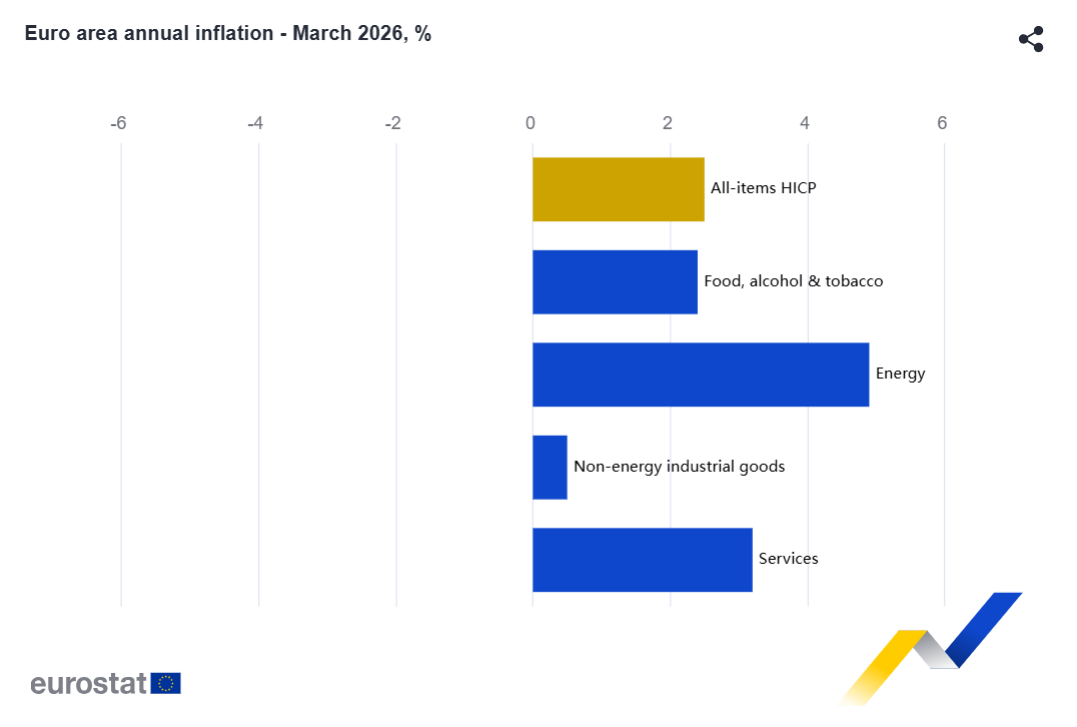 Euro area annual inflation in March 2026 (%). Source: Eurostat
Among the eurozone countries, Croatia had the highest inflation, at 4.7%, followed closely by Lithuania, with 4.5%. Ireland registered 3.6%, while Spain and Greece each recorded 3.3%.
Germany, the economic powerhouse of the euro area, saw 2.8% inflation, 0.8 percentage points higher than its February figure. Italy’s inflation remained unchanged, at 1.5%, and France had a below-average 1.9%.
Meanwhile, Eurostat’s flash estimate showed that core inflation, which excludes energy and food prices as well as alcohol and tobacco, has actually dropped this month, from 2.4% to 2.3%.
At the same time, inflation in the services sector eased slightly, too – from 3.4% to 3.2% – and the prices of non-energy industrial goods fell from 0.7% to 0.5%.
ECB’s response to the high inflation is still uncertain
Analysts are now trying to predict if the European Central Bank (ECB) will return to interest rate hikes in the months to come. While many expect tightening later this year, it’s unclear what the regulator will do in the short term.
Last week, President Christine Lagarde admitted that even a brief spike beyond the target might warrant action on the part of the monetary authority.
She emphasized, however, that the bank will make its decision based on firm data, not forecasts. The next meeting of the ECB’s Governing Council is scheduled for April 30.
According to ING’s Colijn, the likelihood of broader increases in both core inflation and headline inflation grows with the continuation of the war and the disruption it causes. He commented:
“With much uncertainty around how the Middle East conflict will evolve, many scenarios for inflation remain possible, and that’s why the ECB is right to be on high alert.”
BNP Paribas economists Stéphane Colliac and Guillaume Derrien believe core inflation will remain stable in the second quarter and oil will continue to trade above $100. In that case, the ECB may start tightening in June and increase the rate with 75 basis points by the fall.
According to the EU’s Economy Commissioner Valdis Dombrovskis, inflation could exceed 3% this year while output may remain below 1% in both 2026 and 2027.
“For now, the outlook is clouded by profound uncertainty,” he told the media last Friday, warning, “it is clear that we are at risk of a stagflationary shock.”
With that in mind, the ECB is now facing the same dilemma it had to deal with in 2022, the year when the Ukraine war started. The choice is between policy tightening to tame inflation expectations or refraining from rate hikes amid a weakening economy.
Your keys, your card. Spend without giving up custody and earn 8%+ yield on your balance with Ether.fi Cash.
















 English (US)