
 3 months ago
12676
3 months ago
12676

A longtime XRP Ledger builder says XRPL has a narrow shot in 2026 to jump into the top tier of chains on liquidity and activity, but only if Ripple and the XRPL Foundation stop “playing it safe” and prioritize frictionless consumer onboarding, real-world payment rails, and a faster, more aggressive funding engine.
Why 2026 Needs To Be The Year For XRP
Panos Mekras, founder of Anodos Finance, wrote on X that the network’s current metrics are a warning sign: “only a few thousand active users,” daily DEX volume “frequently under $10m,” and AMM TVL “struggling below $50m” roughly two years after launch. The target, he argued, should be explicit: “move into the top 3 networks when it comes to volume, liquidity and overall activity.”
Mekras said the liquidity gap is ultimately an infrastructure and distribution problem. XRPL remains “an isolated island,” he wrote, with limited bridges to other chains and “fragmented, high-fee gateways” instead of seamless on/offramps. His prescription is direct integration of mainstream rails: “native support for major rails like VISA and Mastercard directly within XRPL-based applications” so users can issue cards and spend XRPL assets in real time.
He also framed stablecoin alignment as a competitive constraint: RLUSD reaching a $1 billion market cap in its first year is “positive,” he said, but “$1B is not good enough” against incumbents with $5 billion to $180 billion in circulation that have already become default onramps.
He also argued XRPL lost its consumer narrative after Ripple’s 2014 pivot toward payments and B2B. That shift, in his telling, trained the market to associate XRP primarily with Ripple partnerships rather than the ledger itself, leaving many holders unaware of XRPL’s native DEX and token features. He pointed to a 2023 reply from Ripple CTO David “JoelKatz” Schwartz, who said the DEX ecosystem was strong at the time of the pivot, citing “over $8 million per day in swaps and payments” that Ripple “could 100% confirm” as real activity.
For 2026, Mekras wants XRPL positioned less as “payments” and more as a protocol-layer finance stack where core features are built-in rather than stitched together through smart contracts, with “aggregated liquidity” and “one DEX to rule them all.” A key pillar is “XRPFi,” which he described as an effort to turn “the $100B+ of dormant XRP into productive, yield-generating capital” by pushing XRP liquidity into programmable environments.
He cited Flare’s FXRP via FAssets as a route into smart contracts without “central custodians,” and highlighted Axelar & Midas’ mXRP as an “institutional-grade liquid staking token” he said could enable “5–10% APY,” creating liquid XRP variants that can be used as collateral and AMM liquidity.
The consumer strategy, he argued, should be “invisible infrastructure”: utility apps where users never see crypto mechanics. “If a user is ever prompted to ‘Add a Trust Line’ or ‘Have enough XRP for the reserves’ we have already failed,” he wrote. “The interface must be indistinguishable from the modern mobile apps people already trust.”
To enable that, he called Sponsored Fees and Reserves (XLS-68) the top technical priority so developers can sponsor account reserves and fees, paired with Batch Transactions to compress multi-step actions into “one single, atomic signature.”
Mekras’ sharpest criticism was aimed at grants. He called Ripple’s 2022 commitment of 1 billion XRP to fund XRPL development a “Ghost Fund,” estimating less than $50 million, under 5% has reached active builders in four years. “A grant program that takes 3 months to approve $50,000 and can take another 3 months to receive the money is not a growth engine, it is a bureaucracy,” he wrote, arguing XRPL needs million-dollar checks for proven teams, direct liquidity incentives, and a unified developer experience.
His conclusion was a call for a “war chest mentality” in 2026: fund distribution and liquidity, fix onboarding friction, and build consumer products where XRPL is simply the backend. Without that, he warned, the ecosystem risks remaining a technically capable network that still cannot attract sustained users, builders, or capital at scale.
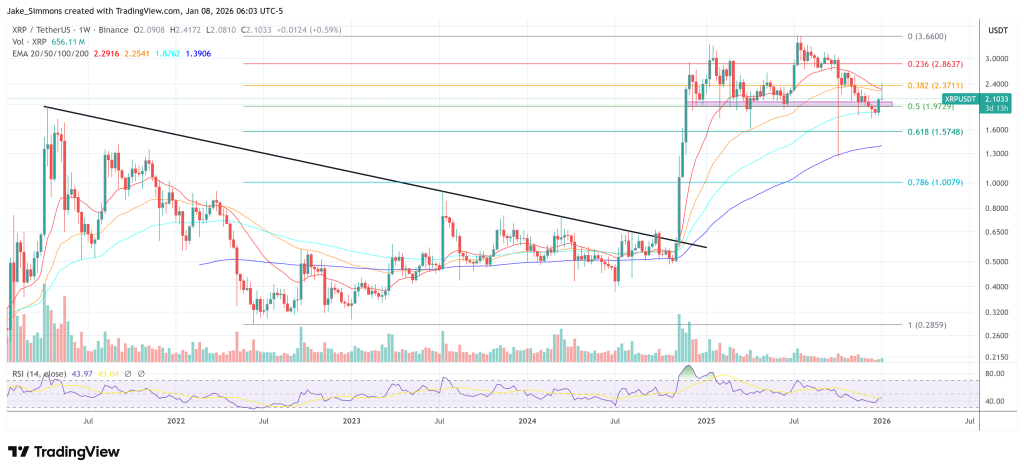
At press time, XRP traded at $2.10.








 English (US)