
 3 months ago
12165
3 months ago
12165

Despite an increasing number of investors discreetly shifting their funds into blockchain-based gold tokens, gold surged back above $4,700 on Wednesday as buyers returned to the market after a severe March selloff.
Spot gold changed hands at $4,719 per ounce on April 1, 2026, up about 1% on the day. Earlier in the session, prices touched $4,750 before pulling back slightly.
Wednesday marked the fourth straight day of gains, building on a sharp 3.5% jump the previous Tuesday, the biggest single-day rise since late January.
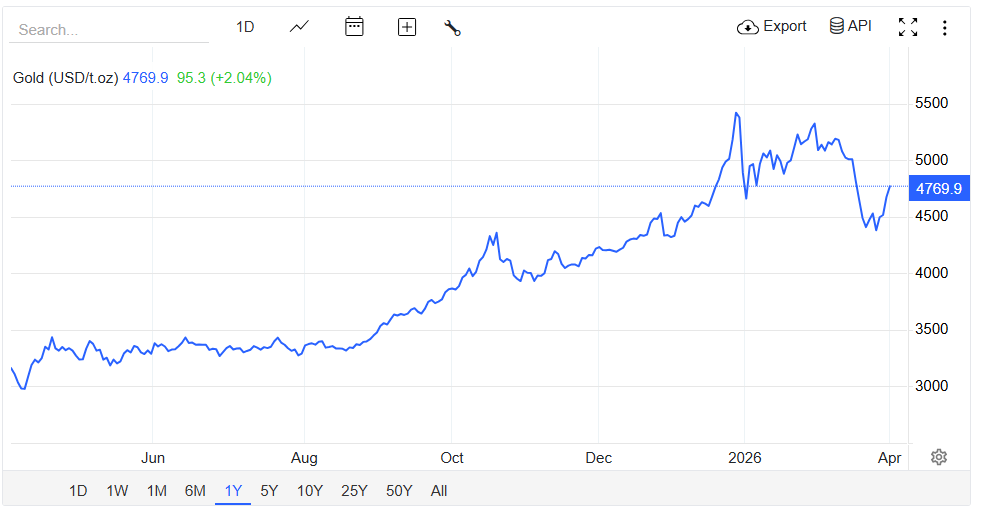 Gold surged past $4,700 on Wednesday
Source: Tradingeconomics
Following one of the worst periods for gold in recent memory, there has been a resurgence. The metal’s worst month since 2008 was March. On March 23, prices dropped from almost $5,100 to $4,100, a decrease of about 15% in just one month.
The Iranian crisis, the Federal Reserve’s refusal to relax monetary policy, and a wave of forced sales by investors who had taken out large loans to maintain their positions were the three factors that led to that collapse.
Now, some of those headwinds are easing. The US dollar has pulled back a little, giving it some breathing room.
Traders are also watching a packed week of economic data. If those figures show the job market is slowing down, the Fed may feel more pressure to cut interest rates.
Tokenized gold draws fresh attention
While conventional gold is making a comeback, another change is taking place.
Tokenized gold, a digital representation of gold ownership stored on a blockchain, is becoming more popular among investors.
Through 2026, this trend accelerated, particularly after tensions in the Middle East made it more difficult for some investors to swiftly purchase or sell it through regular channels.
Tokenized gold gives investors a claim on real, physical gold stored in professional vaults, but the ownership is tracked digitally.
The total market for these products has grown past $6 billion. Within the broader tokenized commodities market, which stood at around $7.4 billion as of March 2026, gold-backed tokens lead the way.
The two biggest are Tether Gold, known as XAUt, with a market size of $3.33 billion, and PAXG, at $2.44 billion.
Proponents of these products highlight several distinct benefits over conventional choices. Unlike stock exchange items, which close on weekends and evenings, blockchain-based assets can be bought, sold, or transferred at any time of day or night.
Additionally, they provide investors with direct ownership of the metal rather than only a stake in a fund structure. Also, the high minimum required to purchase traditional gold bars is eliminated, as customers can buy fractions of an ounce.
Vincent Chok, Founder and CEO of First Digital, said investors are pushing for the kind of liquidity and flexibility that only tokenization can deliver. He also pointed to places like the UAE, where clearer rules on these products are expected to attract more large institutional players.
But not everyone is ready to embrace the concept without caution. Sergej Kunz, Co-founder of 1inch, warned that a tokenized gold product is only as trustworthy as the legal framework, the actual reserves, and the ability to redeem the metal behind it.
He said investors need to carefully check who is issuing the product and who is holding it.
Why Wall Street still sees gold going higher
As for where it goes from here, Wall Street’s biggest banks see more room to run. JPMorgan has set the most aggressive target, calling for $6,300, based on continued central bank buying and a future Fed rate cut.
Wells Fargo is in the same range, targeting $6,100 to $6,300, and recommends buying on price dips. UBS is slightly more measured at $5,600, while Goldman Sachs sits at $5,400, pointing to de-dollarization trends and expected rate cuts as the main drivers.
All four banks agree that purchases by central banks in China, India, Turkey, and Poland will remain a key force holding prices up.
The smartest crypto minds already read our newsletter. Want in? Join them.















 English (US)