
 2 months ago
10399
2 months ago
10399

Strategy now holds more Bitcoin than any other institution or fund worldwide (about 815,061 BTC). According to research firm Galaxy Digital, it could surpass Satoshi Nakamoto within the next two years.
Michael Saylor posted on X, writing, “Winter’s Over,” and Gold advocate Peter Schiff responded by calling the company’s funding model a Ponzi scheme.
How did Strategy get this much Bitcoin?
Strategy (MSTR) started buying Bitcoin in August 2020 while most companies kept their cash in bank accounts or bonds. Saylor exchanged the company’s cash for Bitcoin and kept buying more by selling new shares and issuing debt.
As reported earlier by Cryptopolitan on April 20, 2026, Strategy bought 34,164 BTC for roughly $2.54 billion, according to a filing with the U.S. SEC. That’s an average of $74,395 per coin, bringing the company’s total to 815,061 BTC ($61.56 billion), above BlackRock’s IBIT, which held about 806,178 BTC.
With BTC’s total supply capped at 21 million coins, Strategy now controls 4% of it (1 in every 25 Bitcoin).
Alex Thorn, Head of Firmwide Research at Galaxy Digital, posted an analysis chart on X that suggested Strategy’s total BTC could surpass Satoshi’s somewhere between late 2026 and mid-2027.
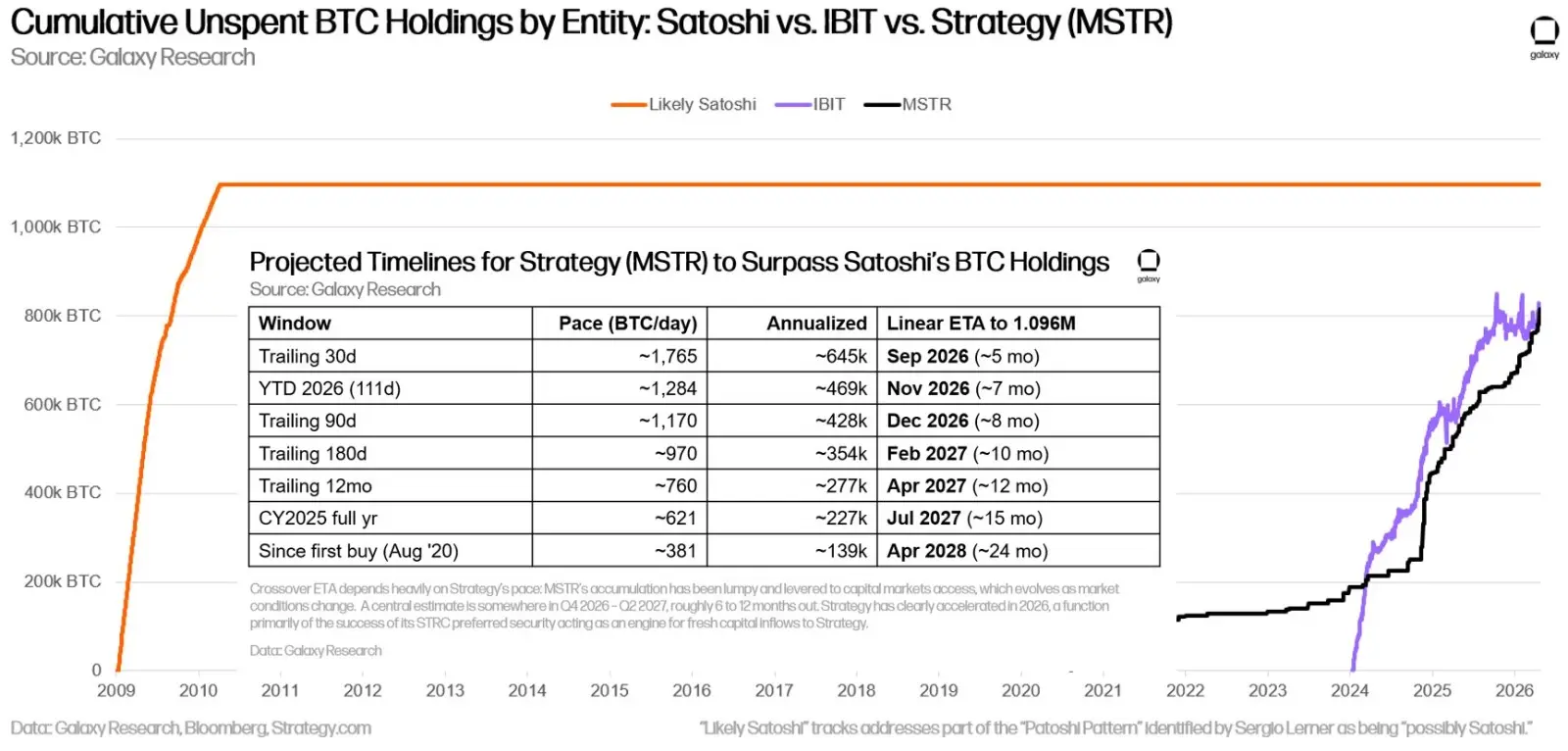 Source: Galaxy Research
Strategy just has to keep accumulating more Bitcoin until its total crosses 1.096 million because Satoshi’s coins have not moved since 2010.
What is STRC, and why does Saylor say “Winter’s Over”?
STRC is a type of “preferred stock” that Strategy uses to pay investors an 11.5% annual return. In essence, the company pays holders a fixed amount regularly, and investors also own a piece of the company rather than just a bond.
Saylor calls STRC a very safe product backed by an appreciating asset, noting that Bitcoin has risen by more than 2% per year over any long period. This means Strategy only needs to rise by 2.05% per year to cover all its preferred stock payments indefinitely.
On April 23, 2026, Saylor posted “Winter’s Over” on X, attracting millions of views in a short time and eliciting replies ranging from enthusiastic to cautious. Users like @OgPashah wrote “Summer is here” in support of the movement. Others like @Admyral1 pushed back with “200 moving average is required before the bulbs of spring emerge… there’s still frost on the ground.”
Bitcoin currently sits at $77,485, which is still below the near $90,000 that it began the year with. However, Saylor suggests it’s moving in the right direction because it fell from about $90,000 to around $68,000 in Q1, then climbed back above $74,000 after Strategy’s recent purchase.
Why Peter Schiff says this is a Ponzi, and why most people disagree
Peter Schiff owns a gold company and has long criticized Bitcoin, calling it a worthless asset. He targeted Strategy’s fundraising approach after the recent BTC purchase and posted on X, saying:
“The main difference between a typical Ponzi scheme and $STRC is that with the former, the promoter doesn’t tell you it’s a Ponzi or that your payments will stop when the pool of new buyers dries up.”
According to Schiff, Strategy relies on a constant flow of new money to pay old investors an 11.5% return, similar to a Ponzi scheme. He even told Saylor to join a live public debate on MSTR and STRC and called out YouTube journalist Coffeezilla for failing to expose Strategy’s scheme.
Schiff received a lot of negative reactions towards his post, with users like @TeslaMadMax saying, “Schiffty is scared… very scared.” Others said raising funds to buy an asset and earn returns is just a standard financial model, not fraud.
Most legal analysts do not think Schiff’s Ponzi label sticks, because Strategy openly states in its SEC filings that dividends depend on raising new capital.
What does this all mean for Bitcoin’s biggest picture?
If strategy surpasses Satoshi, it will be the first time a publicly traded entity holds more Bitcoin than the person who created it. This is either a sign of how far mainstream adoption has come or a warning that BTC is becoming increasingly concentrated in the hands of a single corporation.
According to Alex Thorn, long-term holders support BTC’s price by reducing available supply. On the other hand, having one company own 4% of all BTC creates a corporate chokepoint in a system built to be decentralized.
The impact on Bitcoin’s price would be enormous if Strategy ever faced a financial crisis and was forced to sell its coins.
The crypto card with no spending limits. Get 3% cashback and instant mobile payments. Claim your Ether.fi card.



















 English (US)