
 1 hour ago
1082
1 hour ago
1082
.png)
A public testnet was launched by DogeOS on Wednesday (September 30) that brings the Ethereum-style smart contracts to the Dogecoin platform with an aim to expand the role of DOGE with technology so it can be utilized as programmable capital in decentralized apps other than payments and trades.
Chikyū testnet is a zero-knowledge roll-up compatible with the Ethereum Virtual Machine (EVM) that uses Dogecoin as its coin for transaction fees. The base chain of Dogecoin remains the same, with the applications being built on top of it.
What the testnet actually lets developers do
DogeOS refers to itself as an application layer compatible with EVM, enabling Ethereum developers to utilize familiar codes, dependencies, wallets, and tools. The objective of the network is to facilitate trading, lending, stablecoins, betting on prediction markets, gaming, and various kinds of apps.
DogeOS announced on X that its teams are working in the fields of payment solutions, decentralized finance, gaming, and marketplaces. However, their user manual still shows the list of dApps as “coming soon,” indicating that the developer testnet is not yet a mature ecosystem.
“We’re focused on the public testnet, giving developers time to build and test applications while we validate the network. We’ll share the mainnet timeline as we reach the next development milestones.”
— Jordan Jefferson, DogeOS CEO, speaking to The Block
How the security model works today, and where it’s headed
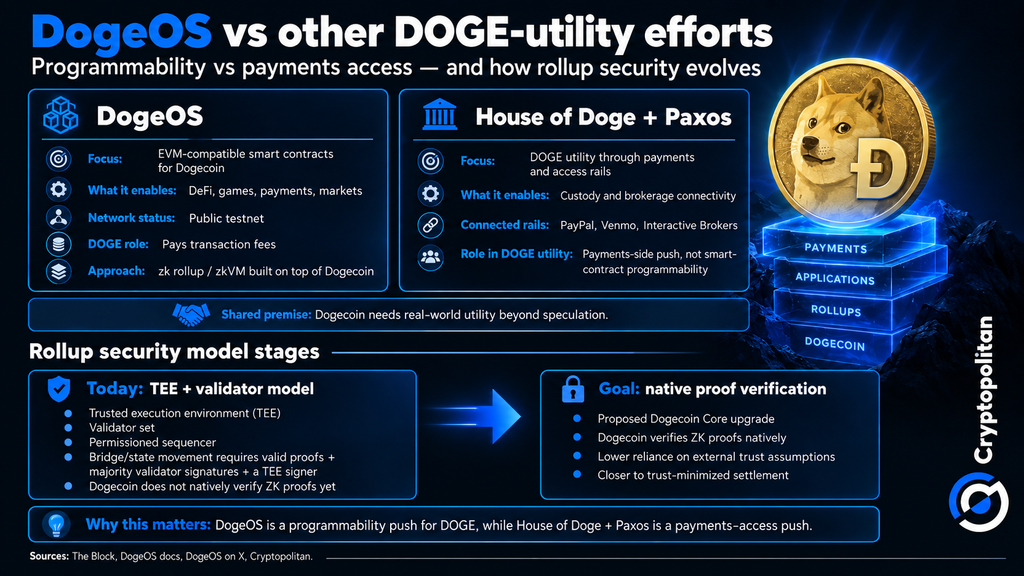
Currently, DogeOS is not entirely trustless. The network depends on a trusted execution environment, validators, and a permissioned sequencer. Dogecoin itself cannot yet confirm the ZK proofs. It has to use valid proofs, the majority of validator signatures, and a TEE signer to transfer through the bridge, according to The Block.
The DogeOS team has announced a proposal for an upgrade to the Dogecoin Core software which will enable ZK proofs to be validated on the base chain platform. However, this is not a definite solution, as the system is also based on other trust assumptions until it is implemented.
 DogeOS vs other DOGE utility efforts: How Dogecoin rollup security works
Whether DOGE’s scale can pull in developers and liquidity
Dogecoin has a huge potential audience. BitInfoCharts claims that there are around 8.5 million addresses of DOGE with positive balance. Keep in mind that an address does not mean an owner; one address can have multiple owners and vice versa.
CoinGecko indicates the market capitalization of DOGE as of October 1 at about $14.7 billion. Comparatively, known EVM rollups have good liquidity for DeFi. DefiLlama shows about $6.3 billion on Base, $1.4 billion on Arbitrum, and $487 million on OP Mainnet.
As of October 1, CoinGecko indicates that DOGE is trading for around $0.0945, which reflects an increase of around 0.3% from the previous 24 hours, with the price fluctuating in the range of $0.0929 to $0.0979. Notably, the slight change in price indicates that the launch of DogeOS testnet has not caused immediate significant volatility in DOGE, although one day trading is too short-time span to draw the conclusion whether the network can convert developers’ interest into real-world use and liquidity.
The BIS bulletin in July warned that proliferation of L1 and L2 networks may contribute to fragmentation of liquidity and infrastructure, with new bridges creating additional trust, governance, and operational dependencies issues.
Dogecoin’s other push toward utility
DogeOS isn’t the sole project that seeks to boost the usability of DOGE. As stated by Cryptopolitan, House of Doge collaborated with Paxos in June to establish a connection between Dogecoin and the custody and brokerage infrastructure employed by PayPal, Venmo, and Interactive Brokers.
The methods vary: House of Doge and Paxos concentrate on payments and accessibility, while DogeOS prides itself on programmability. Whether the developers, liquidity, and native ZK-proof verification be allowed to reach Dogecoin Core or not, will reflect the success or failure of the initiative.
If you're reading this, you’re already ahead. Stay there with our newsletter.














 English (US)