
 6 hours ago
738
6 hours ago
738
.png)
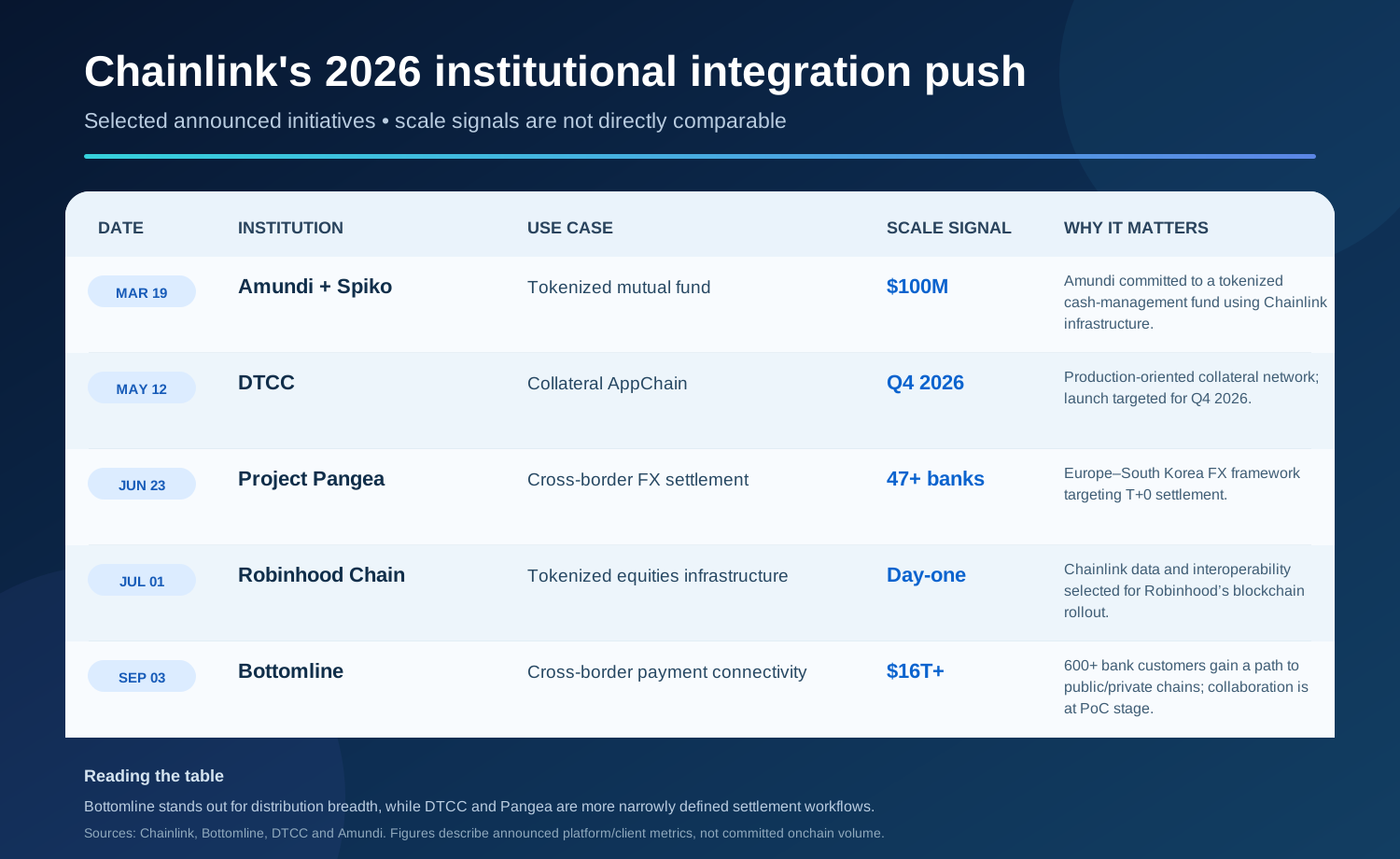
On September 4, Chainlink’s LINK was being traded at $11.88, which translates to a change of 6.8% in the last 24 hours. This follows the announcement of a joint venture of Chainlink and Bottomline, a provider of payments technology. It will enable Bottomline’s bank clients to connect their payments infrastructure with public and private blockchains using Chainlink.
In essence, the significance is huge. Bottomline claims that around 15% of international cross-border transactions on Swift are processed through its platform where it handles over $16 trillion in payments on an annual basis. This could mean that Chainlink can come close to reaching 600 bank clients. However, as of the moment, it remains a proof-of-concept case that has not yet resulted in any actual transfers of $16 trillion worth transactions on the blockchain.
Why a payments giant most traders have never heard of matters
Bottomline Technologies, a company owned by private equity and growth capital firm Thoma Bravo, is engaged in providing payment solutions to over 1 million financial institutions and enterprises across 92 countries worldwide. The company’s Swift connectivity division claims to handle 10 million payments and transactions every day and is ranked as one of the world’s three largest Swift service bureaus.
The mentioned reach differentiates Bottomline from other Chainlink ventures. The Collateral AppChain of the DTCC utilizes Chainlink’s tailored Runtime Environment (CRE) for its collateral handling. The Project Pangea, reported earlier by Cryptopolitan, includes 37 European banks and over 10 Korean banks with completely managed assets, totaling around 10 trillion dollar for the exploration of T+0 settlements in foreign exchange.
Bottomline provides something exceptional as it is a more extensive pathway in utilization of current payment systems, however it is still at an initial stage. Banks likely to be first to use Bottomline are those managing big cross-border payments and using stablecoins or tokenized deposits.
How the banks plug in without ripping out their systems
Banks can continue to send ISO 20022 payment instructions. While the CRE will coordinate the entire process, it is Chainlink’s Cross-Chain Interoperability Protocol (CCIP) that will be responsible for connecting all the different blockchains.
Swift reports that the adoption of ISO 20022 for cross-border payment instructions has reached 97% since the switch in November 2025. The guidance from November 2026 stipulates that either structured or hybrid postal addresses must be used after November 14. With the banks already investing in a standardized infrastructure, Chainlink is working towards expansion, using blockchain settlement as an alternative destination for such messages rather than another core-system migration.
What it could fix for cross-border payments
The 2026 forecast from J.P. Morgan indicates that cross-border payments globally are expected to increase from S194 trillion in 2024 to $320 trillion by 2032, as around 93% of financial institutions are revamping their payment systems.
The BIS’s Project Agorá showed atomic cross-border settlement can be achieved using tokenized central-bank reserves and commercial-bank deposits. BIS General Manager Pablo Hernández de Cos has also noted that stablecoins and tokenized-deposit platforms face interoperability problems. That makes interoperability valuable regardless of which form of tokenized money wins.
Bottomline has identified the practical barrier. Colin Swain, its Global Head of Product for Corporate Solutions, said in a July stablecoin announcement:
“adoption depends on whether finance teams can manage them with the same visibility, controls, and governance they expect from existing payment methods.”
This announcement can clarify the reason behind the growing importance of blockchain connectivity in the established processes compared to making faster transactions only.
According to the joint report of BCG and ADDX, named ‘Relevance of On-chain Asset Tokenization in ‘Crypto Winter’, it has been estimated that the tokenized asset market could be valued at $16.1 trillion by the year 2030. This might explain why there is a growing trend among payment services to treat blockchain-based solutions as a kind of infrastructure rather than a separate experiment.
Where LINK sits after the news
At $11.88, LINK was approximately 77.5% lower than its $52.88 historical peak. CoinMarketCap also indicated that about 748 million LINK tokens are available, out of a maximum supply of 1 billion.
Charles Schwab has also confirmed that LINK, SOL and AVAX will be available on Schwab Crypto soon.
Chainlink’s token economics are of greater relevance to the institutional adoption theory. According to its economics documentation, the revenues that are generated from enterprise use of Chainlink and on-chain services are essentially converted into LINK, which is made possible thanks to Payment Abstraction. More than 5 million LINK is held in reserve on the network.
However, that does not imply that the $16 trillion annual payments of Bottomline would directly lead to the demand for LINK. Neither firm has revealed the monetary institutions involved, how much production will happen, how much in fees will be charged or when this will actually take place. Currently, the market is assessing the likely prospects of such a powerful distribution channel. The real test will come when Bottomline’s bank clients will switch from proofs of concept to the live settlement phase.
If you're reading this, you’re already ahead. Stay there with our newsletter.
















 English (US)