
 3 months ago
13957
3 months ago
13957
.png)
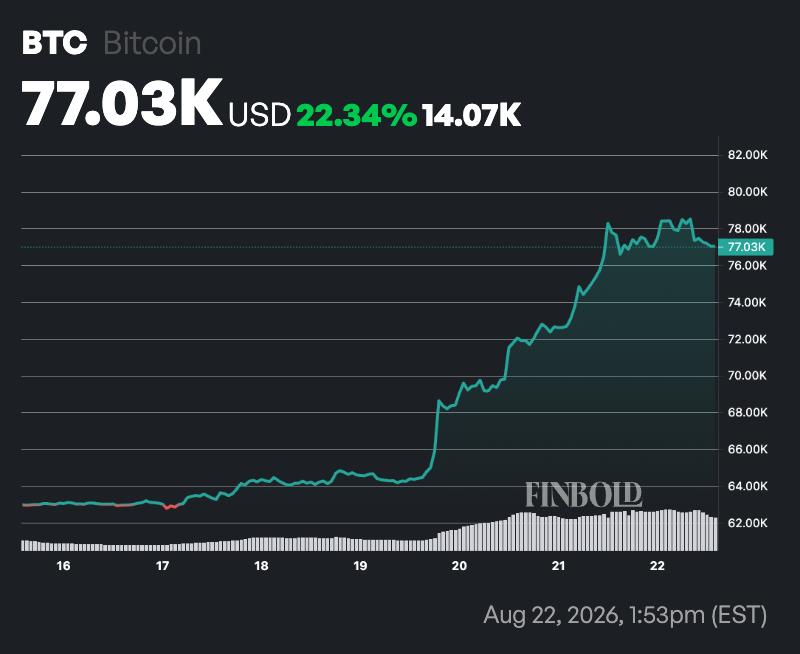
Bitcoin’s weekend crash to below $77,000 in minutes exposed a fragile market structure dependent on institutional liquidity that disappears during off-market hours. Cascading liquidity events over the weekend due to “brittle” order books triggered nearly $100 million in long liquidations almost instantly.
The plunge and subsequent long liquidations were not just a result of bad news, but a mechanical failure of a market that has become increasingly “bifurcated” between deep liquidity weekdays and “ghost-town” weekends.
Professional analysts at OwMarket and Binance argue that Bitcoin has yet to bridge the “Liquidity Sensitivity” gap. They emphasize that the OG token remains a high-beta risk asset on weekends, sensitive to geopolitical or macro noise when the “institutional floor” is absent.
Meanwhile, more analysts are currently focusing on a high-volatility corridor between $74,000 and $82,000 where dense clusters of leveraged positions are most vulnerable to the next market “hunt.” They are also monitoring structural warning signs to predict when the next “cascade” is imminent.
Notably, a 20-30% increase in open interest (OI) over 48 hours without a corresponding price move typically precedes a major deleveraging event within 72 hours. On the other hand, perpetual swap rates exceeding 0.1% (longs overleveraged) or falling below -0.05% (shorts overleveraged) also serve as early warning signals of liquidations.
Standard deleveraging event spirals into broader market ‘air pocket’
The weekend Bitcoin drop vividly illustrates how structural gaps can turn a routine correction into a volatile plunge. In this environment, the lack of active institutional market makers on weekends allowed a standard deleveraging event to spiral into a broader market “air pocket.”
Specifically, automated systems triggered forced closures of leveraged long positions as prices breached psychological levels like $77,000, creating a self-reinforcing downward loop in a market with a few active buyers to absorb the flow. The resulting mechanical selling overshadowed any organic demand, as Bitcoin behaved more like a “liquidity outlet” for cash rather than a “digital gold” safe haven.
Analysts at Kaiko Research also note that Bitcoin is increasingly behaving like a split system: deep and efficient during U.S. weekday hours (driven by ETFs), but brittle and high-risk on weekends. That leaves positions exposed to a “Monday Catch-up” effect, in which markets aggressively reprice as soon as institutional liquidity providers return.
Meanwhile, Kaiko and the BIS have also noted that thin liquidity and high leverage create a “reflexive loop.” Thin books create large price gaps, which trigger more liquidations, further hollowing out the books as market makers pull back to protect capital.
Analysts warn that a daily close below the $74,000-$74,259 level (described as a critical “line in the sand” and technical “supply wall”) would threaten a deeper setback toward the $60,000 psychological floor.
Macro sensitivity forces Bitcoin to trade in tandem with tech stocks
Macro sensitivity stemming from a strengthening U.S. dollar following the nomination of Kevin Warsh to the Fed has intensified the “risk-off” sentiment, forcing Bitcoin to trade in tandem with high-beta tech stocks rather than decoupling.
Viewed as an inflation hawk, Warsh has signaled a preference for “monetary discipline” and a smaller Fed balance sheet. That has provided a “structural floor” for the U.S. dollar (DXY), which, as global liquidity tightens, puts downward pressure on Bitcoin.
Meanwhile, the failure of the U.S.-Iran peace talks in Pakistan (and the subsequent U.S. Navy blockade of the Strait of Hormuz) spiked oil prices toward $95-$110/barrel. However, rather than seek Bitcoin as a hedge, institutional managers have treated it as a liquidity source, selling it alongside tech stocks to cover broader portfolio risk.
Because Bitcoin is now heavily integrated into the same “risk-on-risk-off machinery” as equities via spot ETFs, it is increasingly sensitive to the same macro signals as software and semiconductor stocks.
Don’t just read crypto news. Understand it. Subscribe to our newsletter. It's free.














 English (US)