
 35 minutes ago
864
35 minutes ago
864
.png)
As reported by the Financial Times (FT), leaked documents reveal that the Kremlin-linked A7 network has funneled over $6.9 billion via shell companies and forged shipping documents with the help of international banks. According to the documents, the method of circumvention is no longer a choice between classical banking or cryptocurrency methods. In this case, A7 used both means.
The importance of this context lies in the way that the channels have been interconnected. The same network went from correspondent banking to Tether’s USDT and to the ruble-pegged A7A5 token. According to the FT, international banks executed transactions involving A7 without really being aware of who was behind them, while blockchain investigators followed the trail leading to the sanctioned channels of digital assets.
A banking channel built on forged paperwork
The UK government calls A7 a “Kremlin-backed” system that helps to avoid Western sanctions, assists in military acquisitions and makes oil revenue transactions possible.
On May 26, the British Secretary of State for Foreign Affairs, Yvette Cooper, announced imposing 18 restrictions, saying that A7 claims to have transferred over $90 billion in the previous year that accounts for nearly half of Russia’s annual military expenses.
Alongside A7, the package includes restrictions for a bank in Kyrgyzstan and a global cryptocurrency exchange which the UK suspects of transferring over $1.5 billion to Moscow.
There will be no safe havens for those enabling Russia’s aggression.
— UK Foreign Secretary Yvette Cooper
Russian defense finance institution Promsvyazbank (PSB) and Moldovan businessman Ilan Shor created A7 to aid Russian companies that cannot use regular banks in their cross-border financial transactions, TRM Labs learned in collaboration with the Open Source Centre.
Where the crypto plugs in
TRM discovered that the on-chain operations of A7 linked traditional finance with digital asset intermediaries all over the world. The company has stated that the A7-related on-chain volume exceeded $166 billion, although about $35 billion of this volume was attributed to the circular transaction between A7 and other actors who were involved in evading sanctions, rather than settlements with external entities.
One A7 address received more than $65 million directly from an address TRM attributes to Iran’s Islamic Revolutionary Guard Corps. Another received about $5 million from Hamas. TRM also traced at least $590,000 in proceeds from the BTCTurk and Woo X hacks, attributed to North Korean state hackers, into A7-controlled wallets through intermediaries.
A ruble stablecoin that sanctions made radioactive
Kyrgyzstan-registered Old Vector’s A7A5 is also at the center of the crypto news headlines. Previously, Cryptopolitan reported that the European Union’s 20th sanctions focused on A7A5, RUBx, and the assistance provided to the digital ruble. The U.S. Treasury’s sanctions have included A7 as well as Old Vector.
According to Elliptic, A7A5 successfully transferred $102 billion in the first year of operation through 251,000 transactions, but this number declined to $24.3 million on average per day in June 2026, which is a 96% drop from the peak seen in July of 2025. The drop is mainly attributed to the imposed restrictions that reduced the ways by which traders could convert A7A5 into more liquid stablecoins.
PSB chairman Pyotr Fradkov noted in August that A7A5 had recorded a cumulative turnover of approximately $140 billion from the moment of its launch; the A7 product line has attracted around 15,000 repeat customers.
These numbers should not be confused with one another. The amount of $6.9 billion represents bank-rail flows derived from the leaks. The $102 billion reported by Elliptic and $166 billion reported by TRM represent amounts related to on-chain activity calculated in different ways. The figure of $140 billion by Fradkov refers to cumulative turnover disclosed by the company.
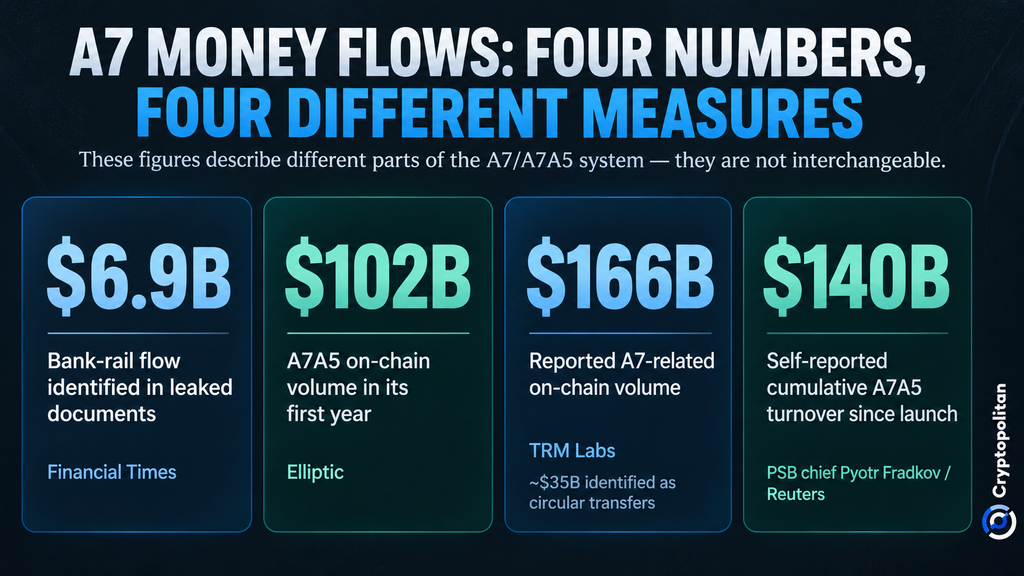 A7 Sanctions Evasion: $6.9B Bank Flows vs $102B, $166B and $140B Crypto Figures
What regulators do with a hybrid network
The case comes as regulators pay closer attention to stablecoins that are harder to freeze. Chainalysis says FATF’s July 16 report card described them as a “significant and emerging risk” and pointed to stronger wallet screening, blockchain analytics, and freezing or blocking capabilities.
There is an important counterpoint. Mainstream stablecoins are traceable, and issuers can freeze, burn, or reissue tokens in some cases. Writing for ACAMS, TRM’s Ari Redbord cited Tether’s April freeze of $344.2 million in USDT linked to Iran’s central bank and noted that less than 0.5% of stablecoin transactions were tied to illicit activity in 2025.
Every transaction settles on a public blockchain, traceable and permanent.
— Ari Redbord, TRM Labs, writing for ACAMS
A7A5 was built to reduce dependence on those issuer-level controls. The wider lesson from A7 is that sanctions exposure can move across bank rails and blockchains inside the same network. The weak point may not be banking or crypto alone, but the gateways where the two meet.
The smartest crypto minds already read our newsletter. Want in? Join them.












 English (US)