
 3 hours ago
951
3 hours ago
951


The post Iranians Increase Self-Custody Bitcoin Reserves Amid Iran-Israel War appeared first on Coinpedia Fintech News
Citizens of Iran are heavily purchasing Bitcoin (BTC) and directing it to self-custody wallets.
A 2026 report from blockchain analytics firm Chainalysis showed an uptick in Iran’s crypto system valuation from $7.4 billion in 2024 to $7.8 billion in 2025.
The report also highlighted that users withdrew roughly $10.3 million worth of cryptocurrencies from major Iranian exchanges to crypto wallets in the 48hours following the US-Israel’s preemptive strike on Iran. Within minutes of the hit, the country’s largest exchange, Nobitex, saw a staggering 700% spike in outflows.
This coincided with a steady uptrend in Bitcoin outflows before and after the January 8 government-imposed internet blackout.
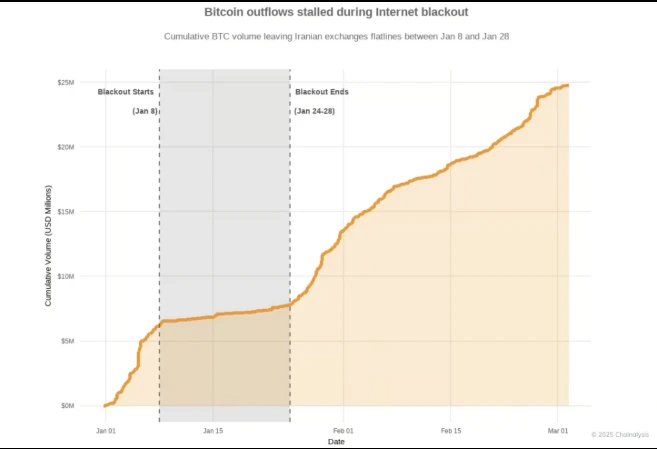
Source: Chainalysis
Bitcoin becomes the financial lifeboat for Iranian citizens
Bitcoin has primarily become a financial haven for Iranians since its long-term value acts as an inflationary hedge. Iran’s native currency, the Rial, has declined 90% in value since 2018. Inflation in the country has also escalated to 40-50%, the highest recorded since World War II.
Additionally, Bitcoin in self-custodial wallets is immune to state/exchange restrictions and security vulnerabilities. In mid-2025, Nobitex suffered a $90 million hack, while Tether continues to blacklist addresses and freeze USDT funds for alleged Iranian conspirators.
Meanwhile, the nation’s central bank (CBI) has suspended rial-crypto conversions several times to prevent further devaluation of the rial. The bank has recently become more accommodating of cryptocurrencies, but on the condition of real-time user surveillance.
Another reason for the migration is the January government-imposed internet blackout, which rendered cryptocurrencies on exchanges useless. Additionally, cryptocurrencies’ digital nature makes them highly portable for those anticipating fleeing the country.
Most importantly, cryptocurrencies allow cross-border remittances despite sanctions such as the SWIFT bank line of disconnects.
Researchers now estimate that 15 million Iranians (20% of the population) are involved with or using Bitcoin, among other cryptocurrencies.
Iran joins sanctioned countries in Bitcoin adoption
Iran, Russia, Venezuela, and North Korea are sanctioned countries that are increasingly pivoting towards cryptocurrencies to bypass international trade restrictions.
Crypto firms Binance and, ironically, the Trump-backed World Liberty Financial (WLFI) are now facing Senate probes related to Iran-linked flows.













 English (US)